
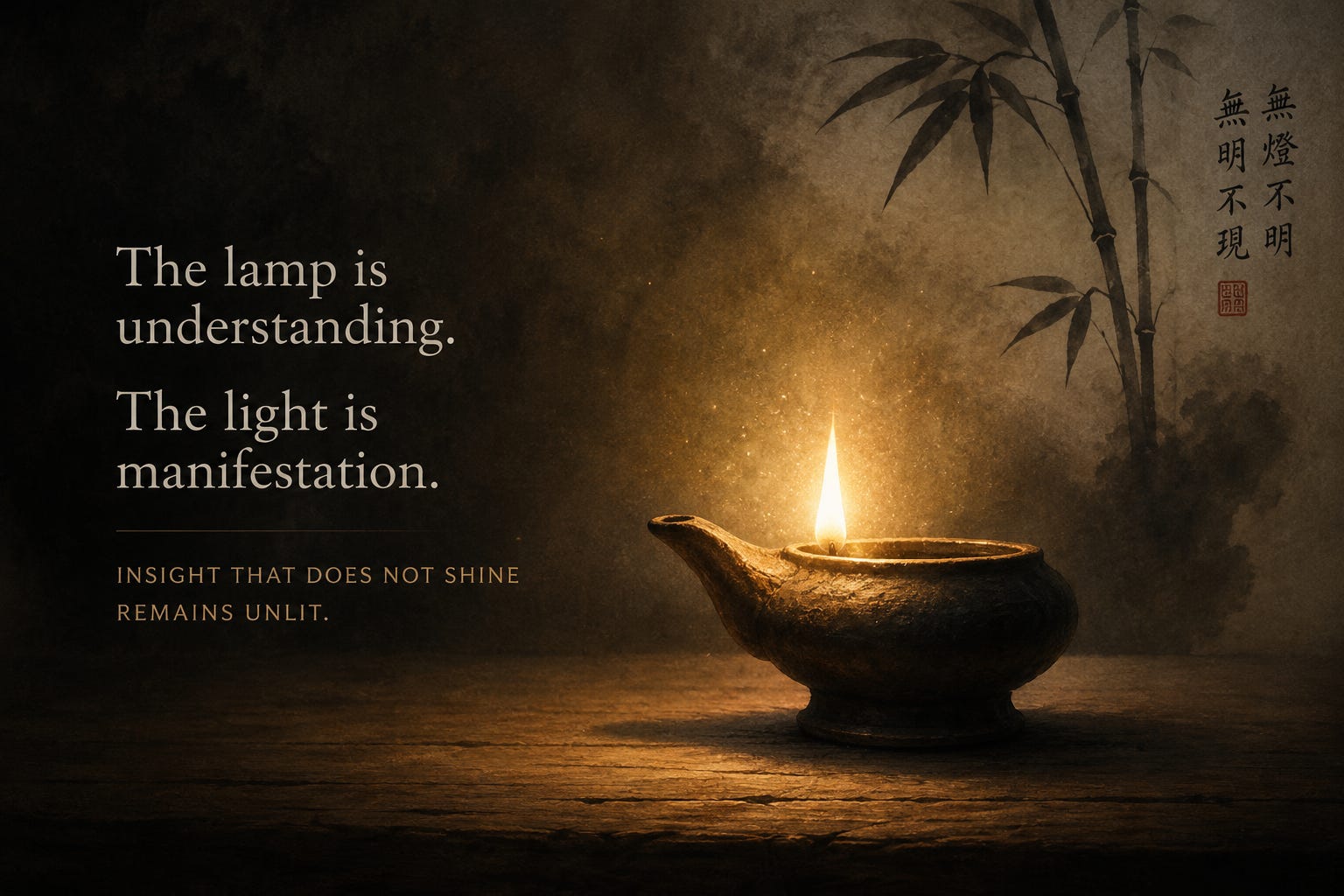
Zen and Metaphors: Lamp and Light
What good is a lamp that never shines?
It sounds almost absurd to ask. The very purpose of a lamp is illumination. And yet, Zen uses precisely this absurdity to point toward one of the most important distinctions in spiritual practice: the difference between understanding and manifestation.
The lamp is understanding.
The light is manifestation.
At first glance, this may seem straightforward. But like most Zen metaphors, it becomes increasingly slippery the longer you hold onto it. Because the moment we begin to separate lamp from light too rigidly, the metaphor collapses.
A lamp without light is incomplete.
Light without a lamp has no source.
And this is exactly the tension Zen attempts to reconcile in practice.
Many people approach spirituality as though collecting understanding were enough. They read books, memorize teachings, discuss nonduality online, and perhaps even accumulate years of meditation experience. But Zen continually asks a more uncomfortable question:
Does your understanding actually illuminate anything?
Because if it does not manifest in your life — in your speech, your actions, your relationships, your presence — then Zen would suggest that the lamp has not truly been lit.
This is one reason Zen traditions place such emphasis on embodiment rather than mere philosophy. Insight is not treated as a private possession or intellectual trophy. Rather, understanding is expected to radiate naturally into conduct, much as light naturally radiates from a functioning lamp.
And importantly, the lamp does not strain to produce light.
It simply shines.
This point matters because many practitioners accidentally turn manifestation into performance. They attempt to “look enlightened,” “act spiritual,” or perform calmness as a kind of identity project. But a lamp does not advertise itself. It does not announce, “Observe how luminous I am.” The light simply appears as the natural consequence of the lamp functioning properly.
Zen repeatedly returns to this inseparability between essence and function.
Dōgen expressed this in the idea that practice and realization are one. In other words, awakening is not something stored away internally while daily life remains unchanged. Realization and manifestation arise together. The lamp and the light are simultaneous activities.
This metaphor also maps beautifully onto the broader framework of Zero and activity.
From the perspective of Zero, the lamp represents the conditions necessary for illumination to arise. The light is the activity itself — the visible expression of those conditions manifesting moment by moment. And just as light inevitably fades when the fuel is exhausted, manifestation is not static or permanent. It continuously arises and disappears.
This is why Zen practice is not about achieving some permanently glowing state of cosmic brilliance. It is about cultivating the conditions under which illumination can reliably arise again and again.
And perhaps this is where the metaphor becomes most personal.
Most people already possess countless “lamps” in their lives:
moments of insight,
moments of stillness,
moments of clarity,
moments where the world briefly slows down.
But these moments are often hidden under distraction, self-concern, endless internal narration, and the constant effort to secure certainty about who we are.
The lamp is there.
The question is whether we are willing to let it shine.
Because ultimately, Zen is not asking you to worship the lamp.
It is asking you to illuminate the room.


