
What if suffering isn’t caused by the world being broken… but by the way we insist it should behave?
That might sound harsh at first. After all, life really does contain loss, disappointment, uncertainty, heartbreak, aging, confusion, and the occasional catastrophic haircut. But Zen points toward something even deeper than the events themselves. It asks us to investigate the structure of the mind that experiences them.
And according to Zen, three interconnected insights sit quietly beneath nearly all human suffering.
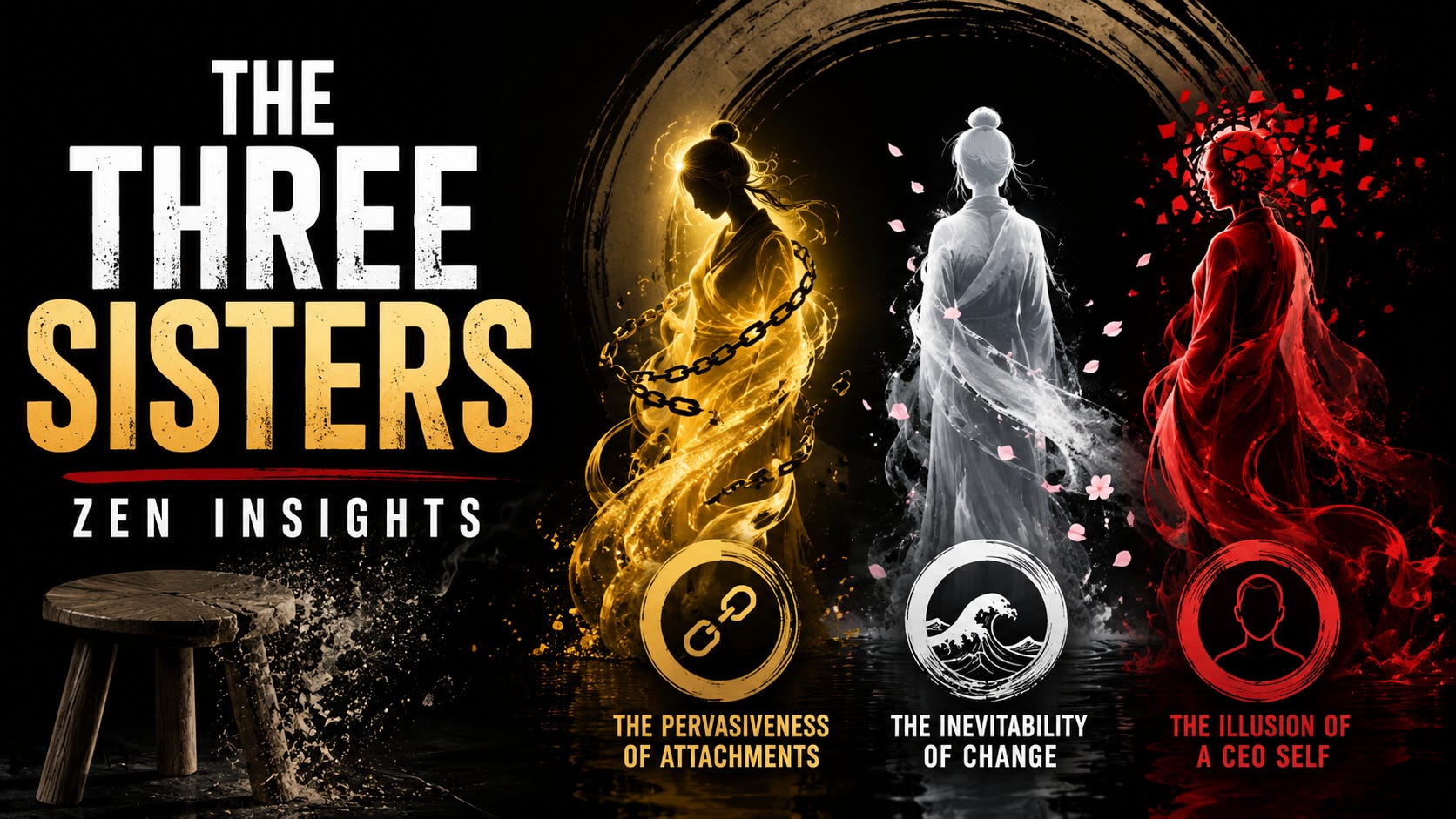
Let’s call them The Three Sisters:
The Pervasiveness of Attachments
The Inevitability of Change
The Illusion of a CEO Self
They are “sisters” because they are inseparable. Tug on one, and the others immediately move. Ignore one, and the others quietly continue running the show behind the scenes.
But here’s the important twist: these are not merely philosophical ideas. In Zen, they are recognized insights of realization. They are things to be seen directly.
And once seen clearly, they change everything.
The First Sister: The Pervasiveness of Attachments
Most people hear the word attachment and think of dramatic emotional dependency. Clinging to relationships. Obsessing over status. Hoarding things. Refreshing social media every twelve seconds like it’s a spiritual practice.
But Zen takes the idea much further.
Attachment is not an occasional mistake. It is the default operating mode of the ordinary mind.
We grasp toward pleasure.
We resist discomfort.
We defend identities.
We attempt to stabilize experiences that cannot be stabilized.
Even the desire to “be calm” during meditation can itself become an attachment.
And zazen exposes this mercilessly.
Sit quietly for long enough and you begin noticing something unsettling: the mind is constantly negotiating with reality. One moment it wants silence. The next it wants stimulation. Then comfort. Then certainty. Then reassurance. Then snacks.
The mind becomes visible as a continuous stream of subtle grasping.
Not because something has gone wrong, but because this is simply what unenlightened awareness does.
The Second Sister: The Inevitability of Change
If attachment is the attempt to hold reality still, impermanence is reality refusing to cooperate.
Everything changes.
Not eventually. Constantly.
Thoughts arise and vanish.
Emotions shift.
Relationships evolve.
Bodies age.
Identities mutate.
Entire civilizations appear and disappear like waves on water.
Zen does not present impermanence as pessimism. It presents it as observation.
The problem is not that change exists. The problem is that we continually negotiate against it. We secretly believe that if we try hard enough, organize carefully enough, meditate deeply enough, or optimize efficiently enough, we can finally lock life into place.
But there is no permanent arrangement.
No final emotional state.
No permanent certainty.
No completed version of yourself.
Just this ongoing unfolding.
Breath after breath after breath.
And strangely enough, this realization can become deeply liberating. Because once we stop demanding permanence from an impermanent world, a tremendous amount of friction disappears.
The Third Sister: The Illusion of a CEO Self
This is where Zen becomes truly destabilizing.
The ordinary assumption is that somewhere inside us there exists a fixed “self” — a central executive running the operation. A little commander issuing orders from behind the eyes.
Zen asks us to look carefully for that entity.
And the deeper the investigation goes, the harder it becomes to find.
There are thoughts.
Sensations.
Memories.
Preferences.
Habits.
Emotions.
Awareness itself.
But where exactly is the permanent owner of these experiences?
Where is the unchanging “I”?
Zen does not say the self is evil or meaningless. It says the self may be more like a process than a thing. More like a story continuously assembled than a fixed object hidden somewhere inside the mind.
The “self” begins to look less like a CEO and more like a committee improvising a presentation with no chairperson.
And this matters because attachment and resistance depend heavily on the assumption that there is a permanent somebody at the center who must constantly be protected, reinforced, validated, and secured.
Once that assumption weakens, suffering begins weakening with it.
The Dance of the Three Sisters
These three insights form a single movement.
Attachments arise because the self wants permanence.
Suffering appears because permanence collides with change.
And both are intensified by the belief in a fixed self at the center of experience.
The sisters dance together.
And Zen practice is, in many ways, the gradual learning to see the dance clearly.
Not intellectually alone.
Experientially.
This is why zazen matters so much in the Zen tradition. Not because sitting itself is magical, but because stillness slows the machinery down enough for these patterns to become visible.
You begin to notice grasping.
You begin to notice impermanence.
You begin to notice the instability of the self.
And slowly, insight stops being theory.
The Lesson of the Three Sisters
Zen enlightenment is not about escaping life.
It is not about becoming emotionally numb.
It is not about floating above reality in permanent bliss.
And it is certainly not about becoming spiritually superior while posting minimalist quotes online.
It is about waking up inside ordinary life exactly as it is.
Without demanding permanence.
Without clinging to identity.
Without requiring reality to obey our preferences before we allow ourselves to live fully.
The Three Sisters are difficult teachers.
But they are honest ones.
And their lesson is simple:
Let go.
Change is coming.
And you are far less fixed than you think.


