
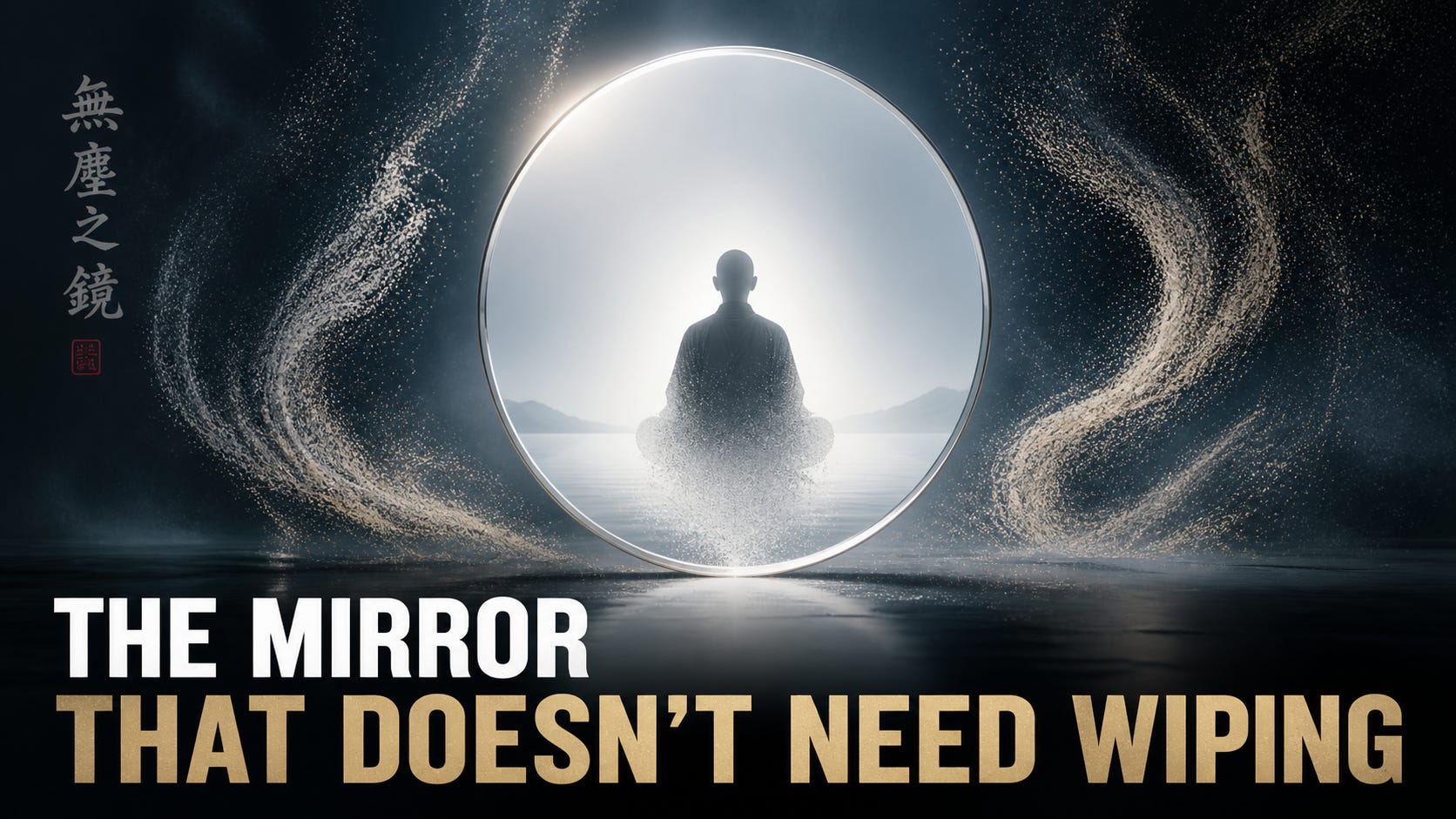
Zen and Metaphors: The Mirror That Needs to be Wiped
What if the problem with your mind isn’t that it’s clouded… but that you believe it ever needed cleaning in the first place?
This is one of those moments where Zen doesn’t gently guide you forward—it pulls the rug out from under you.
The Mirror That Started It All
There’s a famous metaphor that shows up throughout the history of Zen and Buddhism: the mind as a mirror.
A bright, reflective surface that shows reality exactly as it is… except for one issue. Dust. Thoughts, desires, distractions, attachments. These settle onto the mirror, obscuring its clarity. And so, naturally, practice becomes a process of wiping.
Meditation becomes polishing.
Mindfulness becomes cleaning.
Enlightenment becomes a spotless surface.
It’s neat. It’s intuitive. It’s also, from a Zen perspective, deeply misleading.
The Debate That Changed Everything
In early Zen history, a monk named Shenxiu wrote:
“The body is a Bodhi tree,
The mind a standing mirror bright.
Polish it diligently,
And let no dust alight.”
It’s hard to argue with that. It sounds exactly like what practice should be.
But then comes the disruption.
Another monk, Huineng, responds:
“Bodhi originally has no tree,
The bright mirror also has no stand.
Fundamentally there is not a single thing—
Where could dust alight?”
And just like that, the entire metaphor collapses.
The Problem With Wiping
At first glance, the mirror metaphor seems helpful. It gives you something to do. Something to fix. Something to improve.
But look a little closer.
If there’s a mirror, then there must be:
A “you” doing the wiping
A “mind” being wiped
And “dust” that needs to be removed
Three separate things. Three moving parts. Three opportunities for confusion.
Zen sees this and says: this is the problem.
Because now you’re stuck in a loop. You wipe the mirror, but then you notice more dust. You try harder. You refine your technique. You develop better “cleaning strategies.”
And before long, you’re polishing your polishing.
The Subtle Trap of Effort
This is where the metaphor becomes dangerous.
It quietly reinforces the idea that enlightenment is something you achieve through effort. That if you just sit long enough, breathe deeply enough, or concentrate hard enough, you’ll eventually arrive at a perfectly clean mind.
But Zen keeps asking an uncomfortable question:
Who, exactly, is doing the wiping?
Because if that “you” is still there—still striving, still correcting, still improving—then the fundamental illusion hasn’t gone anywhere.
It’s just gotten more sophisticated.
What Zazen Actually Reveals
In practice, this shows up very simply.
You sit.
Thoughts arise. Memories, plans, judgments, distractions. The instinct is immediate: get rid of them. Clean the mirror.
But if you don’t interfere—if you let thoughts come and go—you start to notice something strange.
They don’t stick.
They appear, linger briefly, and dissolve. No wiping required.
And more importantly, whatever it is that’s aware of them… doesn’t seem to change.
It doesn’t get clearer when thoughts disappear.
It doesn’t get dirtier when thoughts arise.
It’s just there.
No Mirror, No Dust
This is the pivot point.
Zen doesn’t replace the mirror with a better metaphor. It removes the need for one entirely.
There’s no mirror.
There’s no dust.
There’s no one wiping.
There is only this ongoing activity—thoughts arising, sensations appearing, awareness functioning—without anything fixed at the center.
And from this perspective, the entire project of “cleaning the mind” starts to look unnecessary.
Zen Optimism
This might sound abstract, but it carries a surprisingly practical implication.
If there’s nothing to fix, then practice isn’t about becoming something else. It’s about seeing clearly what’s already happening.
In the language of Zero, as taught by Joshu Sasaki, what you’re looking for isn’t something added to your experience. It’s the recognition of what everything is already arising from—and returning to.
Not a better mirror.
Not a cleaner reflection.
But the absence of anything that needed improvement in the first place.
And that’s the strange optimism at the heart of Zen.
You don’t have to perfect the mind.
You just have to stop trying to wipe what was never there.


