
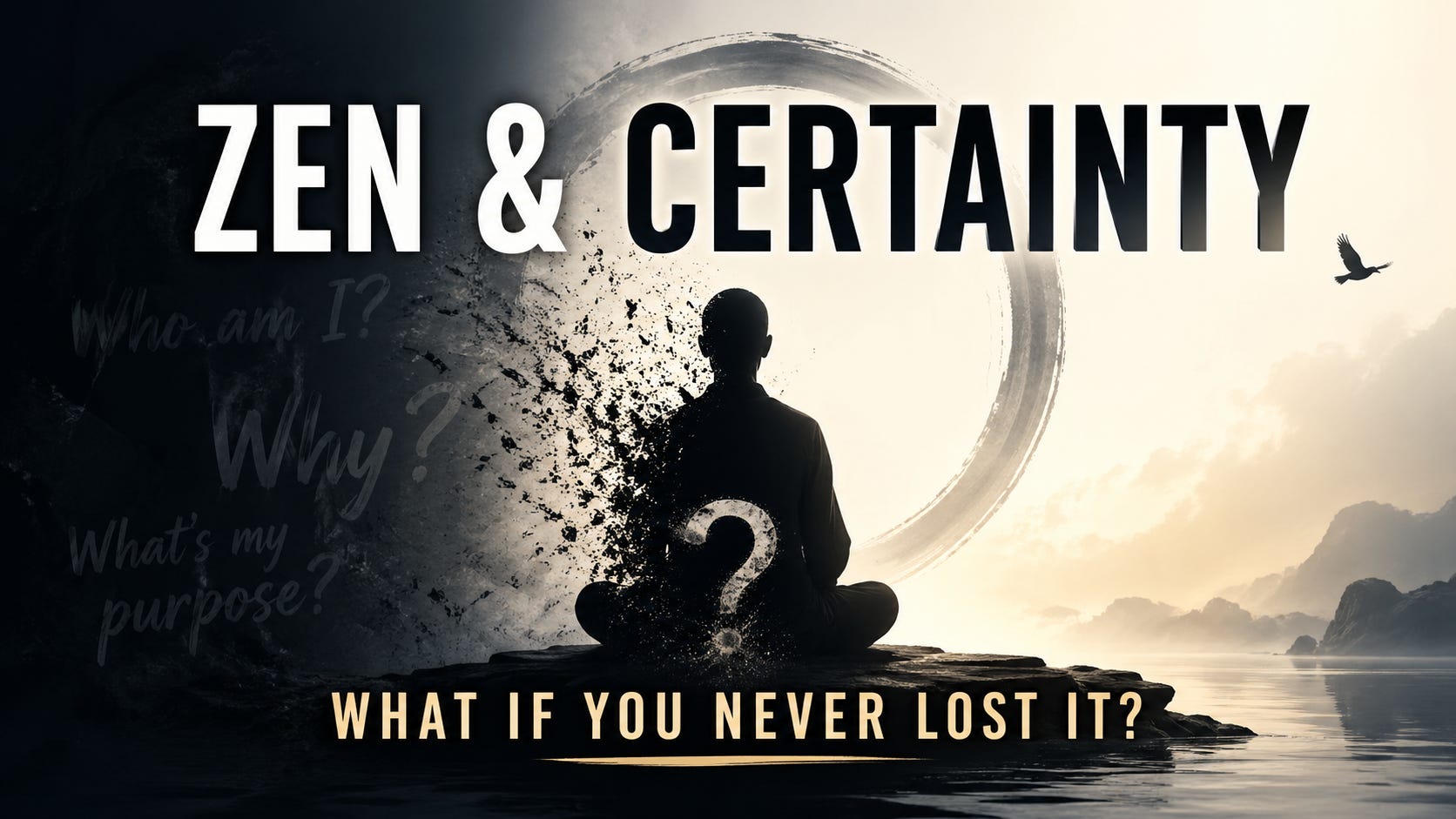
Zen and Certainty: The Thing You Never Lost
What if the certainty you’ve been chasing your entire life—the one about who you are, why you’re here, and what you’re supposed to be doing—was never actually missing?
Not hidden. Not broken. Not waiting at the end of some heroic spiritual quest.
Just… buried.
Buried under a thick, well-intentioned pile of self-improvement strategies, borrowed beliefs, motivational slogans, and endless internal commentary. Layer after layer of “figuring it out,” until the original clarity becomes almost impossible to recognize.
And then Zen shows up.
Not loudly. Not dramatically. No grand entrance. It just quietly walks into the room, looks around at the mess, and asks a question that feels almost insulting in its simplicity:
When you hear a bird chirp… how do you know it’s a bird?
That’s it. No follow-up. No explanation.
And suddenly, the whole project of “certainty” starts to wobble.
Because while you’ve been chasing certainty as something to acquire—something to get—Zen is pointing to something far more uncomfortable:
You’re already operating from a kind of knowing that doesn’t require explanation.
You hear the bird. You know it’s a bird. Not because you ran a checklist. Not because you consulted a philosophy. Not because you paused to confirm your identity first.
It’s immediate. Direct. Unquestioned.
And yet, when it comes to yourself—“Who am I?” “Why am I here?”—that same immediacy seems to vanish. Suddenly, you need answers. Systems. Frameworks. Guarantees.
That’s the tension Zen exposes.
Most people don’t come to Zen because they’re curious about clarity. They come because their usual strategies for certainty have failed.
The new job didn’t fix it.
The new relationship didn’t fix it.
The new routine, the new mindset, the return to old beliefs—none of it quite lands.
And so the questions get louder:
Who am I, really?
What am I supposed to be doing?
Why does none of this feel solid?
At this point, it’s tempting to assume Zen will step in with better answers. More refined ideas. A deeper system.
It doesn’t.
Zen doesn’t hand you certainty.
It dismantles the need for it.
Instead of reinforcing the one who is asking the questions, Zen turns the spotlight back:
Who is asking?
What is this?
Right now—show me.
No philosophy to lean on. No narrative to hide behind. No spiritual GPS recalculating your route.
Just this moment.
And if you actually follow that instruction—if you really sit with it—something strange begins to happen.
Everything you’ve been holding onto as “necessary” starts to loosen.
The story of who you are.
The pressure to define your purpose.
The constant need to interpret and evaluate every experience.
It doesn’t collapse all at once. But it begins to dissolve.
And that dissolving? That’s not a problem.
That’s the doorway.
Because the “certainty” Zen points to isn’t the kind you were trained to seek.
It’s not a conclusion.
Not a belief.
Not a final answer you can write down and defend.
It’s something much simpler—and much harder to accept:
Nothing needs to be added to this moment for it to be complete.
Not your commentary.
Not your identity.
Not your explanation of what it all means.
Just this.
This breath.
This sound.
This flicker of awareness, before it gets wrapped in language.
In Zen, this is sometimes called suchness—or tathatā. The raw, unfiltered presence of experience as it is.
And here’s the twist:
That’s the certainty.
Not the certainty of “I’ve got it all figured out,” but the certainty that nothing is missing. That what’s here, right now, doesn’t require your mental approval to be valid.
No fixed self.
No prewritten meaning.
No need to resolve the entire universe before you can take the next step.
Just direct engagement.
So the questions begin to shift.
Why am I here? becomes:
→ To manifest here and now.
What should I be doing? becomes:
→ Just this.
Who am I?…
That one doesn’t get a clean answer.
It collapses into silence.
Not a frustrating silence. Not a void demanding to be filled. But a silence that doesn’t need to answer back. A silence that reveals the question itself was built on an assumption—that there must be a fixed, knowable “someone” behind it all.
Zen doesn’t replace that assumption with a better one.
It removes the need for one entirely.
So no—Zen won’t give you the kind of certainty you can hold onto.
It won’t give you a belief system to stabilize your identity. It won’t hand you a final explanation that ties everything together.
What it offers is far less comforting—and far more useful:
The ability to stand upright in the absence of all that.
To function, to act, to live—without needing reality to conform to your demand for certainty.
That’s the pivot.
That’s the paradox.
That’s the practice.
Because in the end, the certainty you were searching for wasn’t lost.
It was just buried beneath the effort to secure something that was never required in the first place.
Zen doesn’t dig it up for you.
It shows you where you dropped it.


