
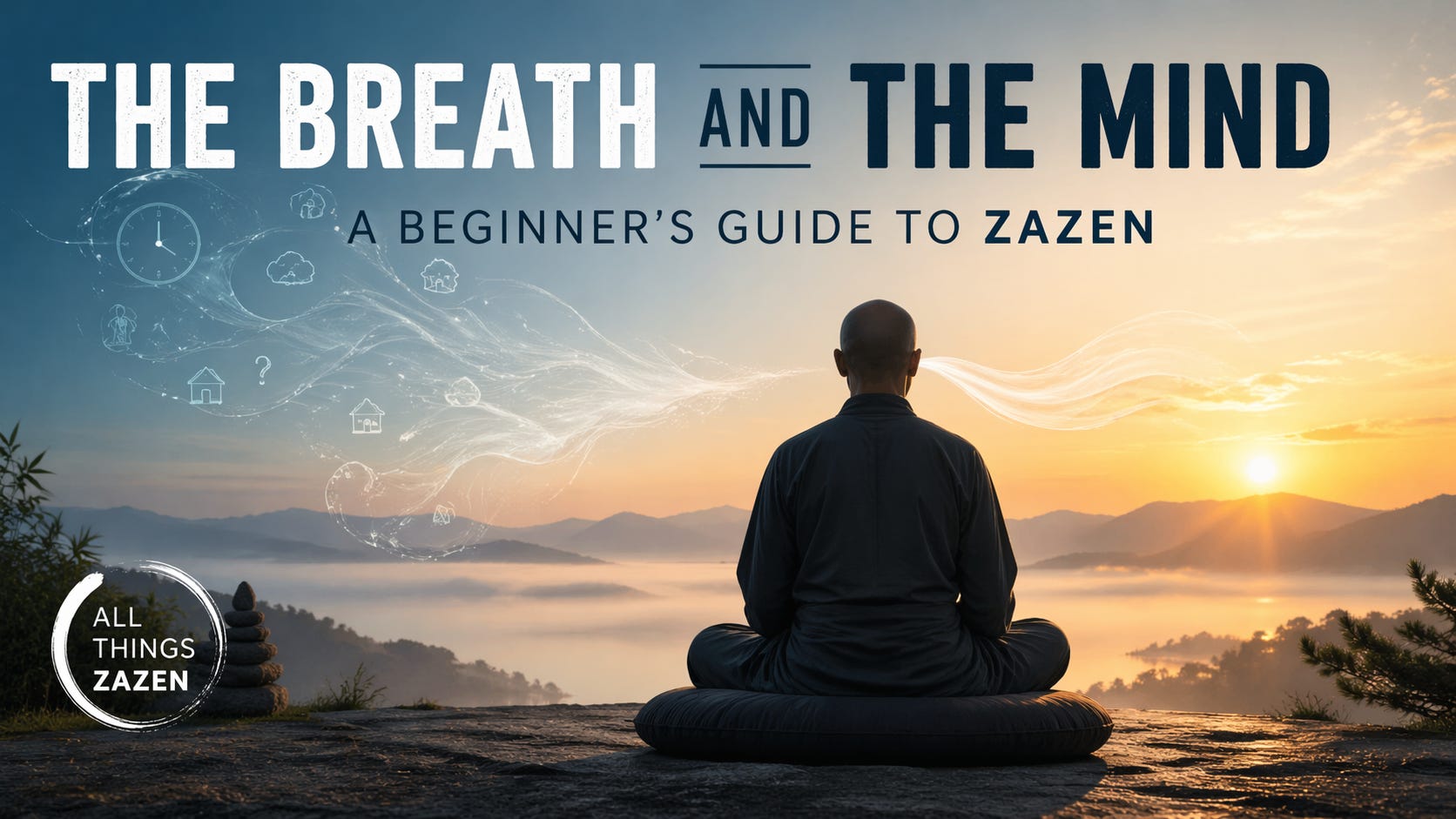
What if the most radical thing you could do today wasn’t changing your life… but stopping it?
Not forever. Just for a moment.
No optimization. No improvement plan. No performance metric. Just sitting still and watching your breath move in and out.
It sounds underwhelming. Almost offensively simple.
And yet, hidden inside that simplicity is one of the most refined practice methods developed in human history.
Let’s get one thing straight: zazen is not about breathing.
If you’re trying to take the perfect breath, you’ve already drifted off course. Because the breath isn’t the goal—it’s the anchor. The excuse. The doorway.
The real activity is something else entirely.
The Three-Legged Structure
Zazen works because it rests on a structure. Think of it as a three-legged stool:
Posture. Practice. Engagement.
Remove any one of these, and the whole thing collapses.
Posture is not about looking like a monk. It’s engineering. You arrange the body—cross-legged, upright spine, hands settled, eyes slightly open—to reduce distractions while maintaining alertness. Not rigid. Not slack. Balanced.
Practice is the method you apply while sitting. And for beginners, the most reliable method is the breath.
Engagement is where things get interesting. It’s the quality of attention you bring. The willingness to stay connected—to the room, the sounds, the sensations—while also noticing when your mind inevitably wanders.
And it will wander.
Constantly.
The practice is not to stop that. The practice is to return.
The Breath as a Gateway
Early Buddhist texts like the Anapanasati Sutta lay out a deceptively simple progression:
First, notice the breath.
Long or short, rough or smooth—don’t change it. Just observe.
Then, follow the entire arc.
From the very beginning of the inhale… to its crest… to the fade of the exhale. Like watching a tide roll in and out.
Then expand.
Let the breath include everything. The sounds around you. The pressure of the cushion. The temperature of the air. The flicker of light behind your eyes.
At this point, something subtle happens.
The breath and the mind stop being two separate things.
They become one continuous activity.
What You Actually Discover
From the outside, zazen looks like nothing.
Someone walks in, sees you sitting still, and assumes you’re trying not to think.
But internally, it’s anything but quiet.
Thoughts rise. Multiply. Collapse. Reform.
Memories appear out of nowhere. Plans try to organize themselves. Emotions slip in unnoticed and suddenly take over the entire field.
And through all of it, the breath keeps moving.
Steady. Unimpressed. Uninterrupted.
Like a silent drummer keeping time while an entire civilization of thoughts builds and collapses around it.
If you stay with it—not forcing, not resisting, just returning—you begin to see something clearly:
The mind is not a thing.
It’s an activity.
The Point (Which Isn’t the Point)
This is where people get tripped up.
They think the goal is to calm the mind. Or eliminate thoughts. Or achieve some special state.
That’s not it.
Zazen doesn’t turn you into a statue. It reveals the machinery that was already running.
And once you see it clearly—really see it—the usual noise begins to lose its grip.
Not because you fought it.
But because you understood it.
It Will Look Like Nothing
There are no fireworks here.
No dramatic breakthroughs. No cinematic moments of enlightenment.
Just sitting.
Just breathing.
Just noticing that what seemed ordinary… isn’t.
And that’s the part most people miss.
Because they’re waiting for something bigger.
One More Thing
If you take anything from this, take this:
The practice is not the breath.
The practice is the return.
Over and over and over again.
And eventually, you might start to wonder:
If the act of returning is the practice… then where exactly were you going in the first place?


