
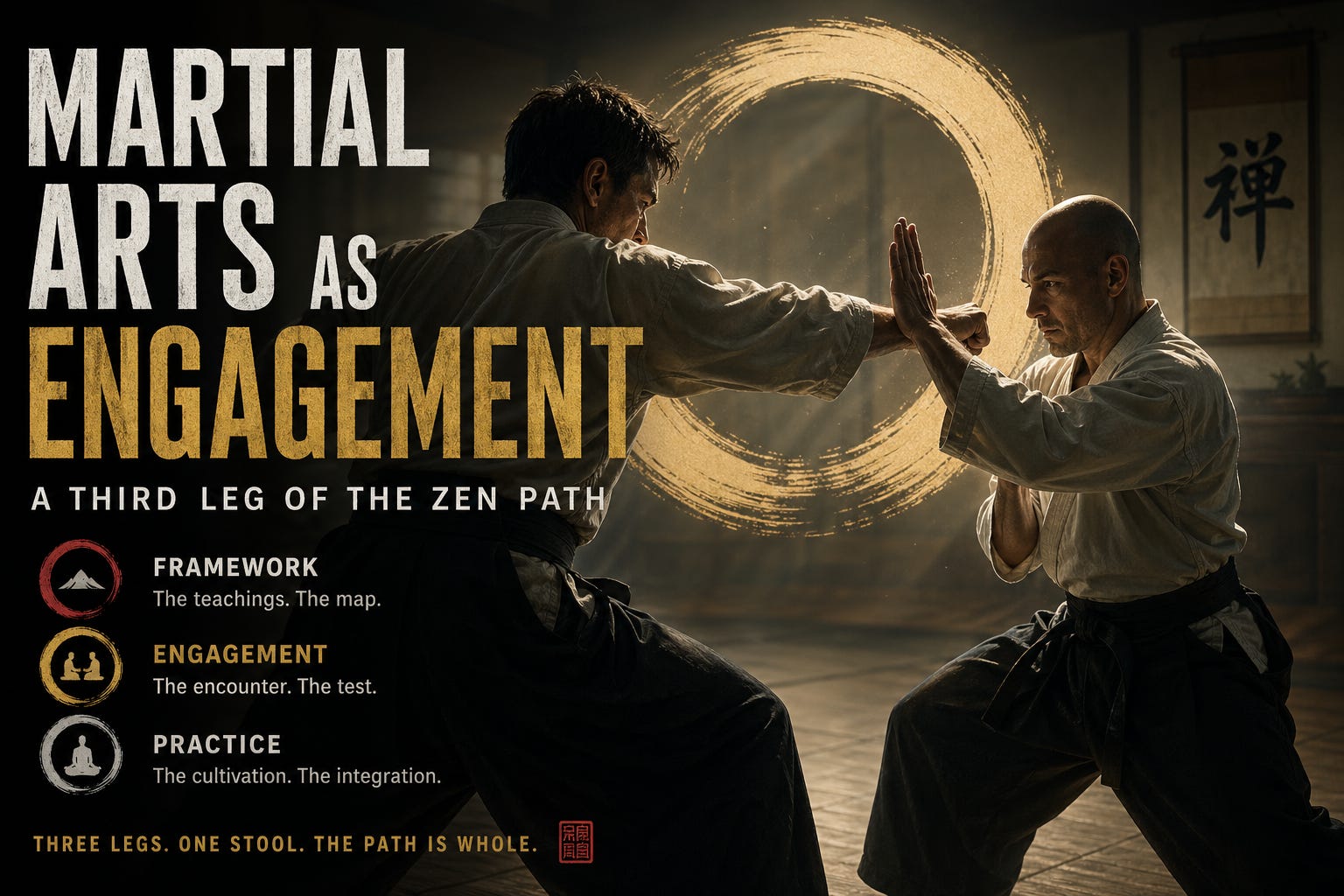
What if the real test of your Zen practice wasn’t on the cushion… but in the moment something unexpected strikes?
Zen training is often misunderstood as something quiet, internal, even passive. Sit still. Watch the breath. Calm the mind. And while there is truth in that, it’s only one leg of the stool. A stable Zen training rests on three: framework, engagement, and practice. Remove any one of these, and what remains may look like Zen—but it won’t function like it.
The framework is the teaching. It’s the structure handed down through a lineage, clarified by a teacher, and internalized by the student. It defines the path, the obstacles, and the destination—what we might call Zen Mountain. Without a clear framework, one can sit for decades and never leave the base.
Practice is the repetition. Zazen. Posture. Returning to the breath. The slow, deliberate cultivation of clarity. Practice is where we begin to see the patterns of the mind, where distraction is reduced just enough for something subtler to become visible. But practice alone is not sufficient. You can become very good at sitting… and still miss Zen entirely.
Which brings us to the missing piece: engagement.
Engagement is where the teachings are tested. Not in theory, not in controlled stillness—but in the unpredictable immediacy of life. Traditionally, this takes the form of sanzen: the direct encounter with a Zen teacher. In sanzen, there is nowhere to hide. The teacher doesn’t care what you’ve read or how calm you feel. They care whether you can see. And they will press, disrupt, and challenge until that seeing is either revealed or exposed as imitation.
Now consider the martial arts.
At first glance, they seem unrelated—physical, competitive, even aggressive. But look more closely. In a martial exchange, thought collapses. There’s no time to analyze, no room to perform. The body moves—or it doesn’t. And in that movement, your mind is laid bare. Hesitation, fear, pride, anticipation—everything shows up instantly.
This is engagement.
The opponent becomes a mirror. Not metaphorically—functionally. They reflect back the exact state of your awareness. If there is a gap between perception and response, it is revealed immediately. If there is clinging—to outcome, to identity, to control—it appears in the timing, in the tension, in the mistake.
In this way, the dojo can resemble a sanzen room. Every exchange is a question. Every reaction is an answer. And occasionally—rarely, but unmistakably—the gap disappears. There is no thinker behind the action, no delay between stimulus and response. Just movement. Just awareness.
But this is where people go wrong.
The martial arts cannot replace a Zen teacher.
They can provoke insight, yes. They can expose confusion, absolutely. But they cannot interpret what is revealed. They cannot point out the subtle ways the self reasserts itself—even in moments of apparent clarity. Without the corrective force of an awakened teacher, what feels like realization can easily become refined delusion. Control masquerades as freedom. Precision masquerades as insight.
And so we return to practice.
Practice is where the pieces are reconciled. It is where the results of engagement—what actually happened in the dojo, in the conversation, in the moment—are brought back into alignment with the framework. It is where contradictions are not avoided, but examined. You may move fluidly in combat and still be bound by self. You may sit in stillness and yet react blindly in the world. Practice is where these gaps are seen clearly and, over time, reduced.
This is why Zen is not a single activity. It is not just sitting. It is not just insight. It is not just action. It is the integration of all three legs: framework, engagement, and practice.
The martial arts, then, are not Zen. But they can serve Zen.
They become a field of engagement—another place where the teachings are tested, where awareness is forced into immediacy, where the illusion of control is challenged again and again. And when held within a proper framework, under the guidance of a true teacher, and supported by disciplined practice, they become something more than combat.
They become inquiry.
So the next time you think about Zen, don’t just picture a quiet room and a still body. Picture movement. Pressure. Contact. The moment where everything you think you understand is suddenly put at risk.
Because that’s where Zen stops being an idea…
And starts becoming real.


