
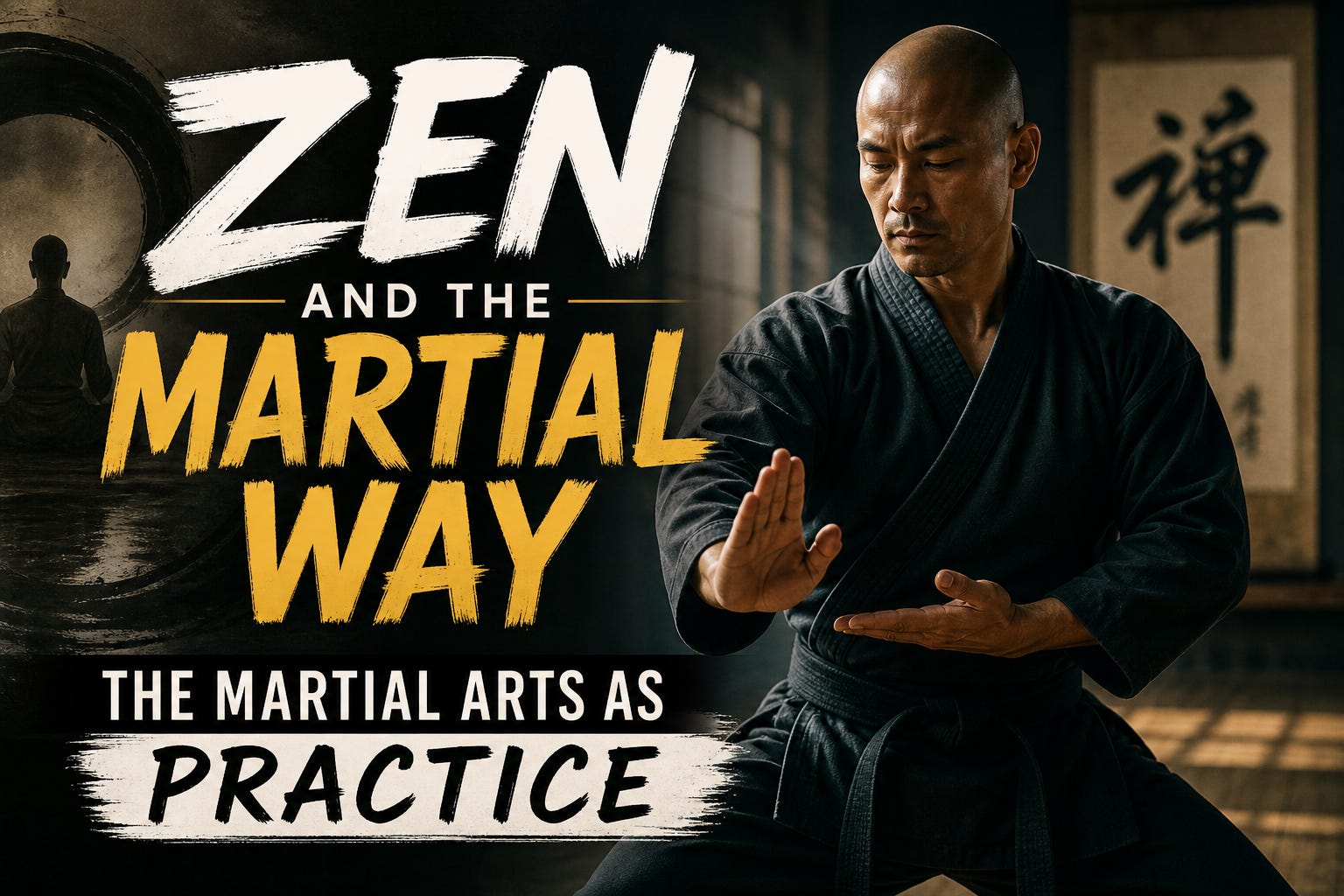
What if your martial arts training isn’t preparing you for a fight… but quietly dismantling the one you think you’re in?
Most people step onto the mat believing they’re there to learn how to strike, block, or defend. And yes—at the surface level, that’s true. But if you stay long enough, if you repeat the same forms thousands of times, something subtle begins to shift. The question stops being “Am I doing this correctly?” and starts becoming “Who is doing this at all?”
In Zen, training is often described as a three-legged stool: framework, engagement, and practice. Remove any one of these, and the whole structure collapses.
The framework gives you direction—a clear sense of what the path is and where it leads.
Engagement—typically with a teacher—tests your understanding and exposes your blind spots.
And practice… practice is where everything becomes real.
In Zen, that practice is often zazen—seated meditation. But here’s the twist: the solo forms of martial arts—kata, poomsae, taolu—can function in much the same way.
Not metaphorically. Literally.
The Form Is the Mirror
At first, a martial form feels like choreography. A sequence to memorize. A pattern to perfect.
But repetition has a way of stripping away illusions.
Run the form once, and you’re thinking about the next move.
Run it a hundred times, and you start noticing your balance.
Run it a thousand times… and you start noticing yourself.
Where does tension arise?
Where does hesitation creep in?
Where do you try to control instead of allow?
The form doesn’t lie.
Just like in zazen, where sitting still reveals the restless machinery of the mind, the martial form reveals the same thing—but in motion. Every misalignment in the body reflects a misalignment in attention. Every forced movement exposes a mind that is trying too hard.
The form becomes a mirror you cannot avoid.
When Movement Becomes Practice
Here’s where things get interesting.
Most practitioners stay stuck at the level of performance—trying to make the form look right. Cleaner lines. Sharper strikes. Better timing.
But Zen doesn’t care how it looks.
Zen cares about what remains when the performer disappears.
In zazen, you’re not trying to become still—you’re uncovering the stillness that’s already there beneath the noise. In the same way, in a martial form, you’re not trying to impose control—you’re allowing movement to arise naturally from a place deeper than intention.
There’s a moment—and it’s fleeting—where the transition happens.
The movement is no longer “yours.”
The breath is no longer “managed.”
The sequence unfolds on its own.
And suddenly, there is no gap between stimulus and response. No hesitation. No commentary.
Just movement.
This is what Zen points to—not perfection, but spontaneity. The kind that arises when nothing is in the way.
Form and Emptiness, in Real Time
Zen teachings often say: form is emptiness, emptiness is form.
It sounds abstract. Philosophical. Maybe even a little mystical.
But in a martial form, it becomes tangible.
Each movement arises.
It exists briefly.
And then it disappears completely.
No movement carries over. No stance clings to the next. Each moment is total—and then gone.
You begin to see that the form isn’t a fixed thing. It’s not an object. It’s an activity—continuously arising and dissolving.
Sound familiar?
It should. This is the same insight Zen points to everywhere: that what we think of as solid, continuous, and “real” is actually a dynamic process—appearing and disappearing moment by moment.
The martial form just makes it impossible to ignore.
The Trap: Practice Without Direction
Now here’s the part most people don’t want to hear.
You can do forms for decades… and never touch any of this.
Why?
Because practice alone is not enough.
Without a clear framework, you don’t know what you’re looking for.
Without engagement—especially with someone who sees through you—you don’t know when you’re fooling yourself.
And make no mistake: the ego loves disciplined environments. It thrives on improvement, on mastery, on the subtle identity of “I am getting better.”
You can become incredibly skilled… and completely miss the point.
This is why Zen insists on the full three-legged stool. The form can take you far—but not all the way.
The Opportunity Hidden in Repetition
And yet… the opportunity is undeniable.
Because every time you step into a form, you are given the same invitation:
To align the body so distractions fall away
To let breath anchor awareness
To move without clinging to movement
To observe, directly, the arising and passing of experience
This is not separate from meditation.
It is meditation.
Just not the kind that sits still.
When the Dojo Becomes the Cushion
At a certain point, the distinction starts to blur.
The dojo is no longer a place to train techniques—it becomes a place to observe mind in motion.
The form is no longer preparation—it becomes expression.
The repetition is no longer tedious—it becomes revealing.
And the biggest shift of all?
You stop trying to get somewhere.
Because you begin to see that every step, every turn, every breath… already contains the whole thing.
Final Thought
The martial arts, when approached deeply, don’t just teach you how to fight.
They show you the structure of experience itself.
Not through theory. Not through belief.
But through repetition so honest, so direct, that eventually… there’s nothing left to hide behind.
And in that moment—when the form performs itself—you’re not practicing Zen.
You’re looking straight at it.


