
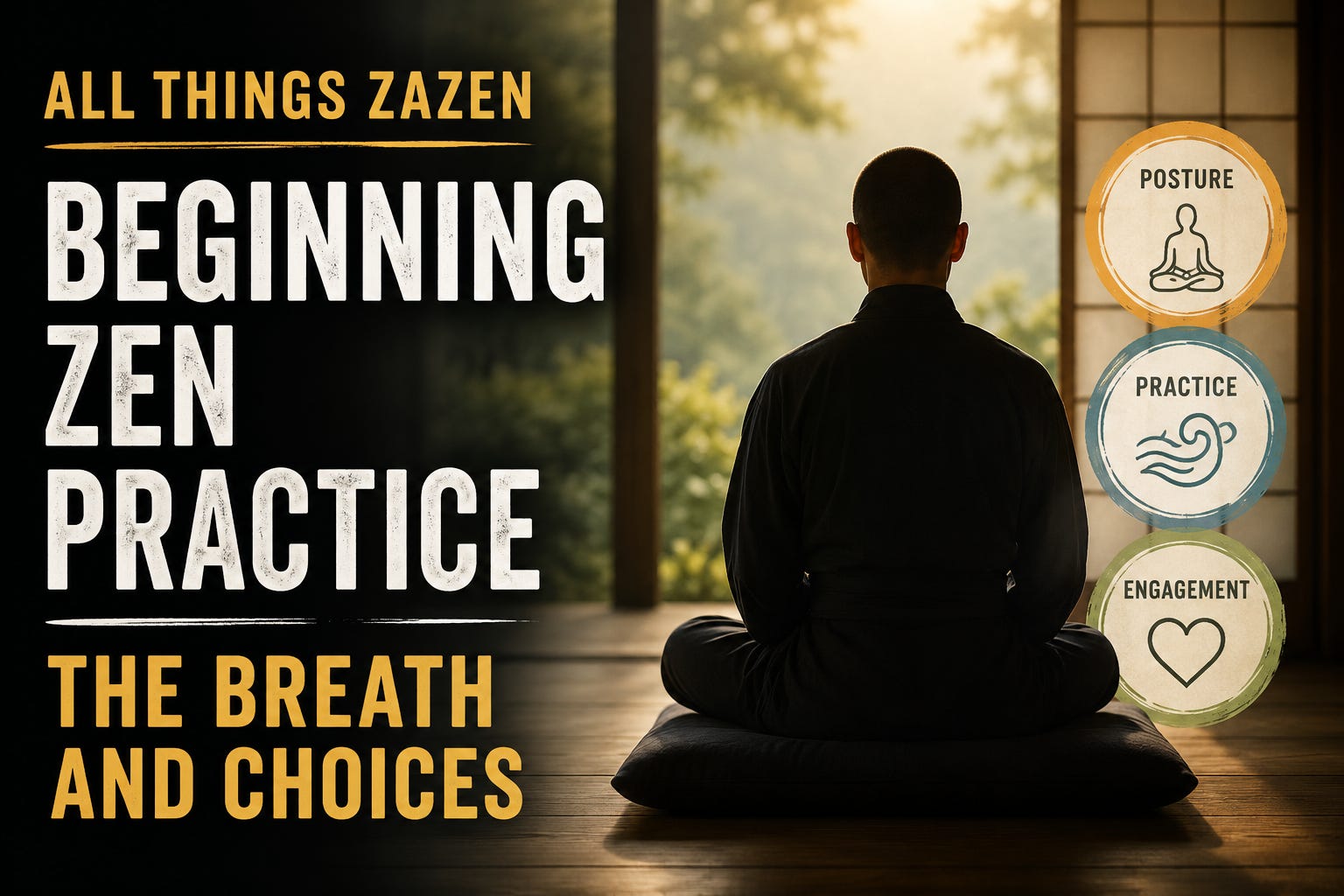
Beginning Zazen Practice
What if the most radical act you could take today wasn’t quitting your job, wasn’t running a marathon, wasn’t even mastering intermittent fasting…
But sitting absolutely still and watching yourself breathe?
Not exactly the stuff of Instagram glory. No dramatic soundtrack. No transformation montage. No one applauding your “mindfulness journey” from the sidelines.
And yet, hidden inside this absurdly simple act is one of the most refined systems of self-observation developed in human history.
This is zazen.
Not incense.
Not mysticism.
Not escaping reality.
Just your body, a cushion, and the air you’re already breathing.
But here’s the important part: zazen is not merely “sitting there doing nothing.” It is a carefully balanced activity. In fact, it helps to think of it like a three-legged stool.
The first leg is posture.
Your body is arranged in a way that minimizes distraction while still encouraging alertness. Cross-legged. Upright spine. Hands folded gently near the belly. Eyes partially open. Stable, but not rigid.
Not monk cosplay.
Engineered stillness.
The second leg is practice.
This is the actual method you employ while seated. And contrary to popular belief, there isn’t just one method in Zen. Some schools emphasize “just sitting,” where awareness remains wide open without a specific anchor. Others use koans — those frustrating riddles designed to corner the intellect until something deeper begins to move.
But for most beginners, there is a simpler gateway:
The breath.
And the third leg is engagement.
This is the quality of attention you bring to the entire process. The willingness to stay connected with circumstances while noticing when the mind wanders off into fantasy, memory, planning, anxiety, or internal argument.
And then gently returning.
Not punishing yourself.
Not grading your meditation performance.
Just returning.
Three legs. One stool.
Remove any one of them, and the whole thing collapses.
The breath practice itself is deceptively simple. The Ānāpānasati Sutta — the Buddha’s discourse on mindfulness of breathing — lays out a progression that functions almost like a training map.
First, simply notice the breath.
Long or short.
Deep or shallow.
Smooth or rough.
Warm or cool.
Don’t improve it.
Don’t optimize it.
Just observe it.
Then expand awareness to include the entire arc of each breath. The beginning, middle, and end. The rising and falling. The crest and dissolution.
Like watching waves arrive at shore and disappear again.
But eventually, something else becomes impossible to ignore.
Choices.
Tiny choices.
Constant choices.
Relentless choices.
The urge to close your eyes.
The urge to fidget.
The urge to scratch your face.
To stretch your legs.
To clear your throat.
To sigh dramatically like an exhausted philosopher in a foreign film.
And this is where practice deepens.
Because now, rather than merely attending to the breath, you begin attending to the choices that arise around the breath.
You breathe while noticing the urge to move.
You breathe while noticing the urge to react.
You breathe while noticing the choice to remain still.
At first, this may sound almost trivial. But in practice, it reveals something profound: much of what we normally call “me” is actually a continuous stream of impulses, reactions, negotiations, and unconscious habits unfolding moment by moment.
Zazen slows this process down enough for you to finally see it.
Not intellectually.
Directly.
And strangely, from the outside, it looks like absolutely nothing is happening.
Someone walks into the room and sees a person sitting quietly on a cushion.
Internally, however, entire worlds are rising and falling. Thoughts surge forward. Emotions appear out of nowhere. Impulses demand action. Narratives form and dissolve. And beneath all of it, the breath continues like a silent metronome quietly marking time.
No fireworks.
No mystical laser beams.
No instant enlightenment package arriving overnight.
Just breathing.
Choosing.
Returning.
Again and again and again.
And eventually, something once ignored becomes impossible to ignore.


