
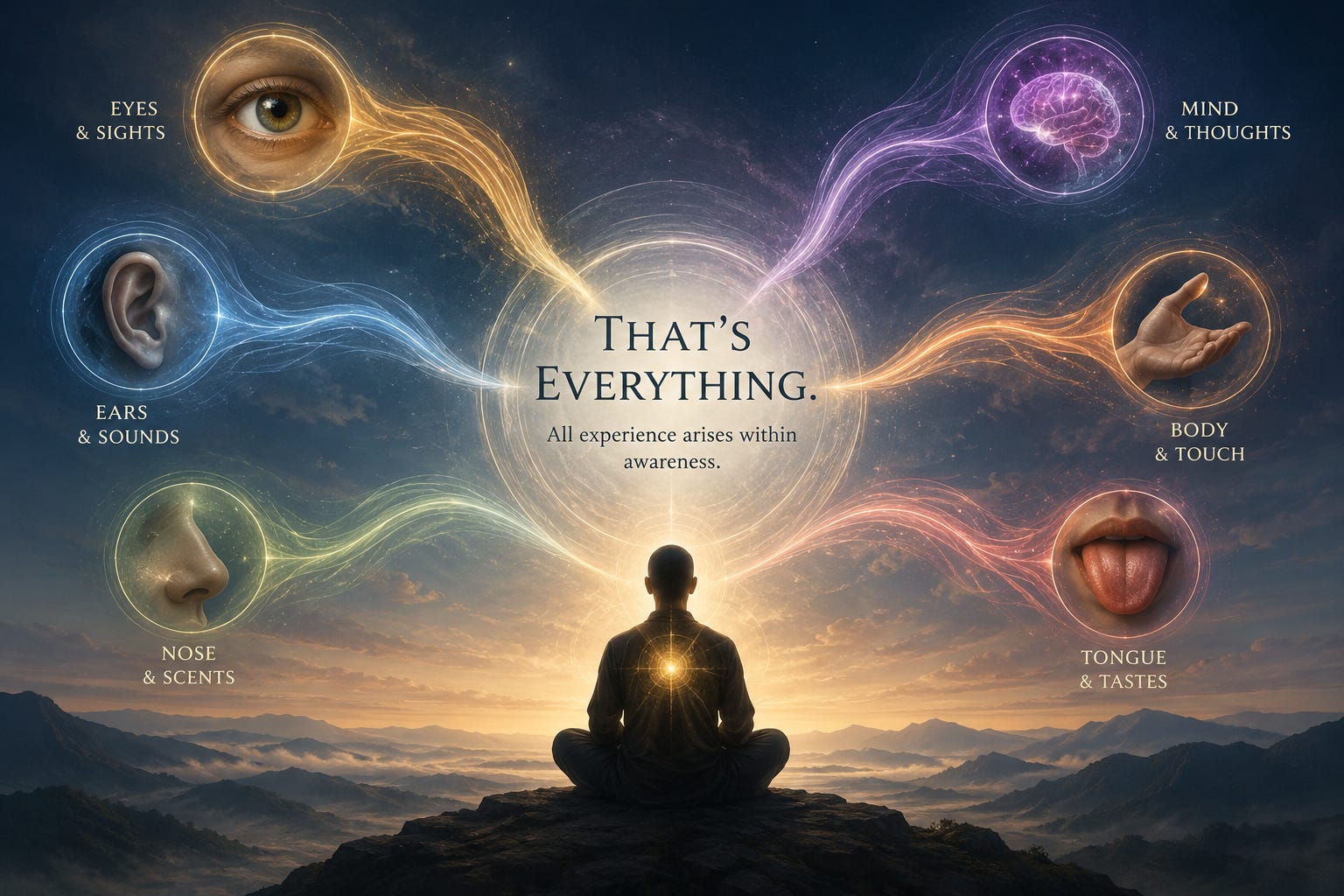
The Dance of a Deeper Explanation: That’s Everything
What if everything you have ever experienced could be reduced to a surprisingly short list?
Not your possessions. Not your accomplishments. Not your beliefs. Not even your memories.
Everything.
The Buddha proposed exactly such a list. He described the totality of human experience in terms of six sense bases: the eyes and sights, the ears and sounds, the nose and scents, the tongue and tastes, the body and touch, and the mind and thoughts.
At first glance, this seems almost disappointingly simple. Surely reality is more complicated than that.
And yet, the more closely we examine the matter, the more difficult it becomes to find anything that falls outside this framework.
Every mountain you have ever seen appeared as sight.
Every song you have ever heard appeared as sound.
Every fragrance, every flavor, every sensation of warmth or cold, every memory, every hope, every fear, every philosophical insight, every religious conviction, every scientific theory—all of them arrived through one or more of these six gateways.
The Buddha’s point was not merely that these are the ways we encounter reality. His point was more radical.
These six sense bases constitute the entirety of the world as it is experienced.
There is no seventh category.
There is no hidden chamber beyond experience where reality secretly resides.
Everything that can be known appears within this field.
This observation leads to a fascinating question.
What about the self?
After all, most of us spend our lives feeling as though there is a distinct “me” standing behind experience, observing the sights, hearing the sounds, and thinking the thoughts.
But if the Buddha’s analysis is correct, where exactly would such a self exist?
If it exists, it must appear somewhere within the field of experience.
It must be something seen, heard, felt, remembered, imagined, or thought.
Yet the moment we identify it in one of these categories, it becomes just another object of awareness.
A thought about the self is a thought.
A feeling of self is a feeling.
A memory of self is a memory.
An image of self is a sight within the mind.
The self continually appears, but it always appears as content within awareness rather than as something standing outside of awareness.
This is where the Buddha’s teaching on the five aggregates becomes particularly useful.
The aggregates are form, consciousness, perception, feeling, and volitional formations.
Together, these create the appearance of a person.
Form provides the body.
Consciousness illuminates experience.
Perception recognizes patterns.
Feeling assigns value.
Volitional formations generate intentions and reactions.
As these activities unfold, a remarkable thing happens.
The mind begins constructing a story.
That story says there is a separate individual behind the experience.
An owner of the body.
A possessor of the thoughts.
A controller of the feelings.
A permanent witness watching the show.
The Buddha understood that this process is inevitable.
The appearance of self is not a mistake.
It is a natural consequence of the aggregates interacting with one another.
The problem is not that the self appears.
The problem is that we believe the appearance.
In the Anattalakkhana Sutta, the Buddha asks us to examine the aggregates carefully.
Are they permanent?
No.
Are they fully controllable?
No.
Do they remain exactly as we wish them to remain?
Again, no.
And because they are impermanent and conditioned, they cannot reasonably be identified as a permanent self.
Thus, the notion of a separate self must ultimately be rejected—not because it never appears, but because it cannot withstand careful investigation.
Zen approaches this same realization from a slightly different angle.
Rather than analyzing the self piece by piece, Zen often points directly to the immediacy of experience itself.
What is hearing?
Just hearing.
What is seeing?
Just seeing.
What is thinking?
Just thinking.
Remove the labels and assumptions, and experience becomes astonishingly simple.
The eyes and sights.
The ears and sounds.
The nose and scents.
The tongue and tastes.
The body and touch.
The mind and thoughts.
That’s everything.
Joshu Sasaki Roshi described the underlying condition of experience as “Zero.”
Before subject and object divide, before self and world appear, there is Zero.
From Zero arises the entire dance of awareness.
Seeing.
Hearing.
Touching.
Thinking.
Remembering.
Imagining.
And from these activities emerges the appearance of a self.
Yet throughout the entire process, Zero remains unchanged.
The self appears within awareness.
The world appears within awareness.
Thoughts appear within awareness.
And awareness itself remains unconfined by any of them.
This realization is not intended to produce a new belief.
It is intended to inspire investigation.
Can you find something outside awareness?
Can you locate a self that exists independently of sights, sounds, sensations, and thoughts?
Can you discover anything that is not already appearing within this field of experience?
The invitation of Zen is not to answer these questions intellectually.
The invitation is to look.
To see directly.
To experience for yourself what remains when the search for a separate self comes to rest.
What remains is neither mysterious nor distant.
It has been present from the beginning.
The eyes and sights.
The ears and sounds.
The nose and scents.
The tongue and tastes.
The body and touch.
The mind and thoughts.
Nothing excluded.
Nothing added.
That’s everything.


