
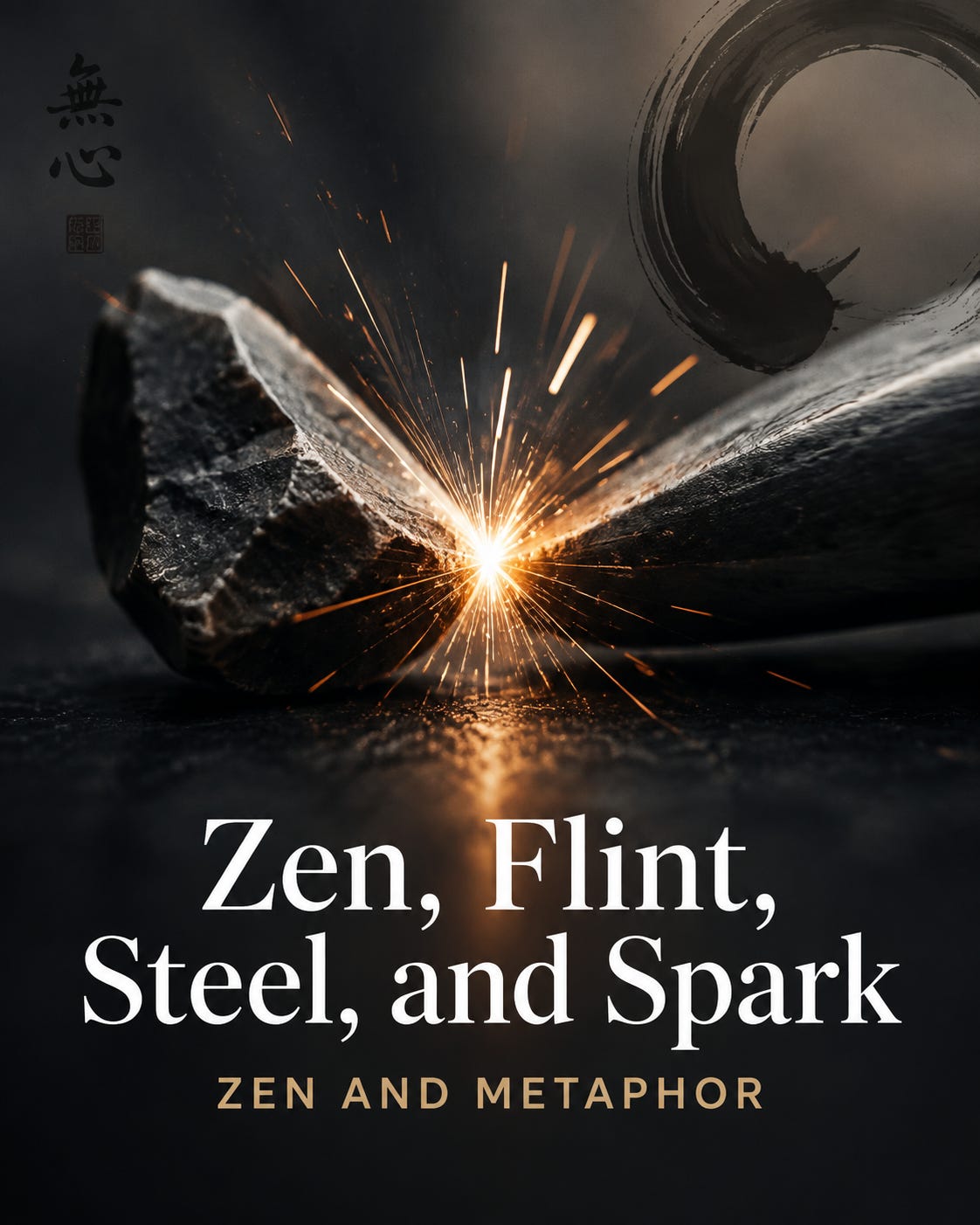
Zen, Flint, Steel, and Spark
What happens when the world asks you a question—and there is nobody there trying to come up with the answer?
Flint strikes steel.
Spark.
That may be one of the simplest ways to understand what Zen means by spontaneity.
The spark in this metaphor does not represent enlightenment. It does not represent some sudden flash of profound insight. It represents something considerably more practical: the immediacy of response that becomes possible when the sense of self does not insert itself between circumstance and action.
Consider sanzen.
You enter the room. You bow. You sit before the teacher.
Then the teacher presents a koan.
At that moment, something very interesting can happen.
The question is heard.
Then you think:
What does he want?
What did I say last time?
Was that answer wrong?
What did that book say?
Maybe I should say this.
Maybe I should do that.
And suddenly there are three people in the room: the teacher, the student, and the little committee inside the student’s head desperately trying to avoid embarrassment.
No spark.
The problem isn’t necessarily that the eventual answer is intellectually wrong. It might even be brilliant. The problem is that something appeared between the question and the response.
The sense of self appeared.
Before Thinking
Flint and steel provide a wonderfully unforgiving metaphor because the physics doesn’t negotiate.
When flint strikes steel properly, the spark appears immediately.
There is no conference.
The steel doesn’t announce, “Give me a moment to process that.”
The flint doesn’t wonder whether it made a good impression.
Contact and response are effectively one event.
Zen practice attempts to cultivate something similar in human activity.
This is sometimes described as acting “before thinking,” but that phrase can easily be misunderstood. Zen isn’t advocating stupidity, recklessness, or impulsiveness. There are plenty of situations where thinking carefully is exactly what circumstances require.
Rather, “before thinking” points toward the possibility of responding without the additional interference of a separated sense of self.
The difference is subtle but enormous.
There can be perception.
There can be awareness.
There can be action.
There can even be thought.
What need not be present is the additional activity declaring:
“I am the one doing this.”
The Spark Is the Response
This changes how we understand the metaphor.
The spark isn’t some reward waiting at the end of years of Zen practice.
The spark is the response itself.
A teacher asks.
You answer.
Something falls.
You catch it.
Someone calls your name.
You turn.
Circumstance appears, awareness meets it, and activity manifests.
Flint.
Steel.
Spark.
The interesting question becomes: How much exists between the strike and the spark?
For most of us, quite a lot.
Memory. Preference. Fear. Expectation. Self-consciousness. The desire to succeed. The desire not to fail. The desire to appear enlightened—which, in a Zen interview, is probably one of the more entertaining ways of demonstrating that you aren’t.
All of these can create distance between circumstance and response.
Zen training progressively investigates that distance.
Why Practice?
This also helps explain why Zen practice can appear so repetitive.
Sit.
Stand.
Bow.
Walk.
Eat.
Work.
Repeat.
If enlightenment were merely a matter of acquiring the correct philosophical understanding, this would seem absurdly inefficient. We could simply read a sufficiently good explanation and be finished by lunchtime.
But Zen isn’t merely training what we know.
It is training how we meet circumstances.
Zazen cultivates stillness.
Forms cultivate attention.
Koans disrupt habitual conceptual responses.
Sanzen places the practitioner directly into an encounter where hesitation, calculation, and self-consciousness become remarkably difficult to hide.
Again and again, the flint approaches the steel.
Sometimes nothing happens.
Sometimes there is smoke.
Sometimes the practitioner proudly produces something resembling a spark and discovers that the teacher remains spectacularly unimpressed.
And sometimes—
spark.
The Selfless Response
The absence of self should not be confused with the absence of a person.
The student doesn’t vanish.
The body remains. Awareness remains. Perception remains. The capacity to respond remains.
What disappears, however briefly, is the need for a separate “I” to supervise the proceedings.
And this may be why spontaneous Zen responses can seem so striking.
They aren’t necessarily profound.
They are immediate.
Nothing appears to have been added.
Nothing seems to have been held back.
Circumstance and response form a single continuous activity.
That is the spark.
And like an actual spark, it doesn’t last.
It flashes and disappears.
The moment you turn around and think, “Wow, that was a really good spontaneous response,” congratulations—the committee has reconvened.
Fortunately, life is already raising another piece of flint.
Another sound.
Another question.
Another inconvenience.
Another person.
Another moment requiring a response.
The goal isn’t to preserve the previous spark.
It is to remain available for the next strike.
Flint.
Steel.
Spark.
No hesitation.
No performance.
And, for just that instant, nobody standing between the world and its response.


