
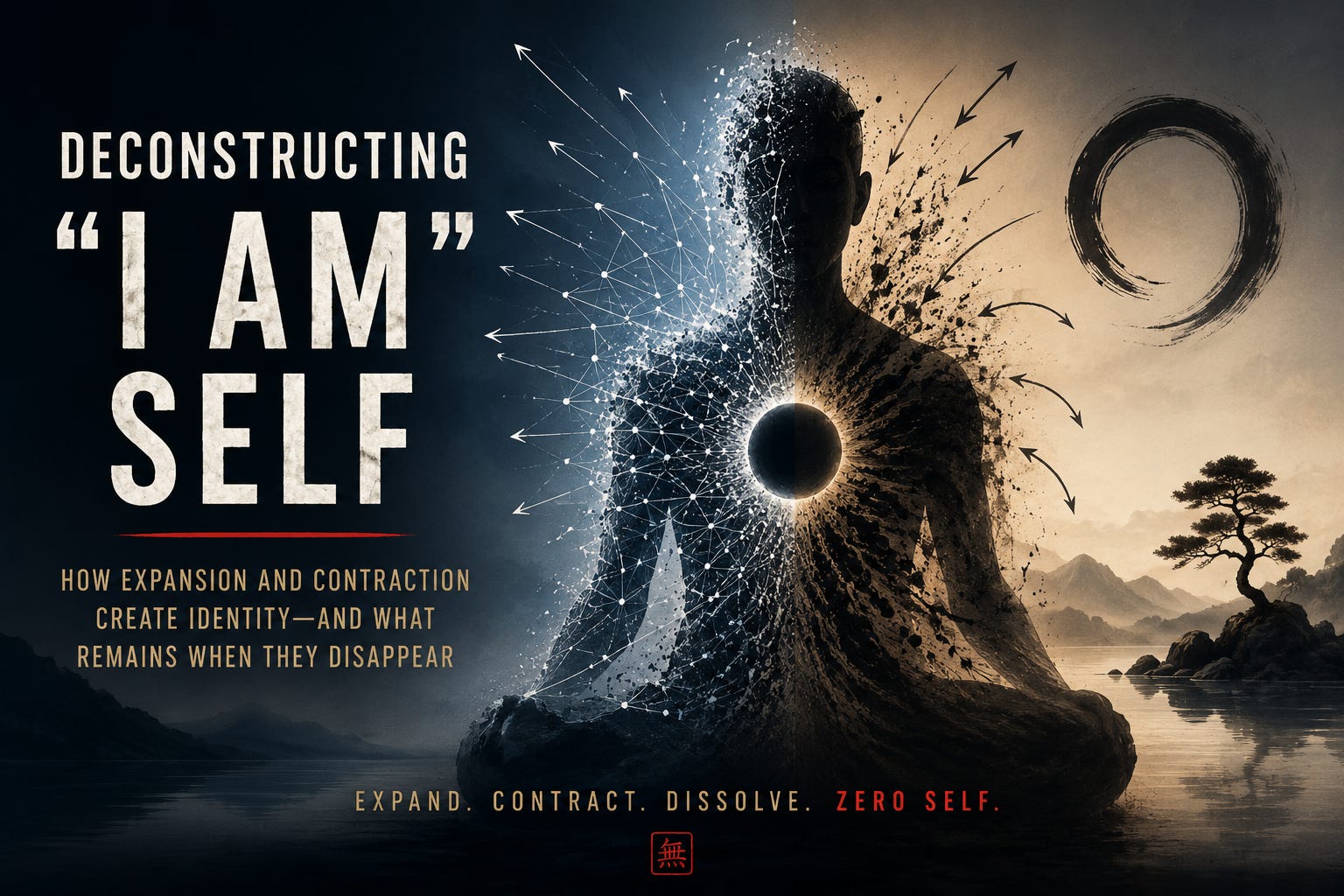
Deconstructing the “I Am” Self
Most of us spend our lives assuming that the phrase “I am” points to something real, permanent, and self-evident. After all, who could be more familiar than ourselves?
Yet Zen has a way of turning the obvious into a question.
When we look closely, the self appears less like a thing and more like an activity. More specifically, it appears as the result of two naturally opposing activities. One expands outward, continually claiming experience: “I am this.” The other contracts inward, releasing those claims: “I am not this.”
The fascinating implication is that the self may not be a fundamental feature of reality at all. Rather, it may be the temporary equilibrium produced by these opposing tendencies. Expansion gathers. Contraction releases. The familiar sense of “I” emerges in the tension between them.
This perspective aligns closely with the teachings of Zen master Joshu Sasaki, who frequently described reality in terms of naturally opposing activities. In his language, Zero inevitably splits into expansion and contraction, and those activities inevitably disappear back into Zero. Applied to the question of identity, the implication is profound: the self is not what remains when the activities disappear. The self is one of the things that disappears.
What remains is what we might call the Zero Self.
The Zero Self is not a better self, a spiritual self, or a perfected self. It is simply what remains when neither expansion nor contraction is constructing an identity. It is awareness free from the need to become someone. It does not depend upon affirmation. It does not depend upon denial. It is not built from what is accepted or rejected.
In this week’s essay, Decide For Yourself: Deconstructing the “I Am” Self, we explore how identity emerges from the interaction of expansion and contraction, why the “I am” Self is inherently unstable, and how practices of observation and inquiry can accelerate its dissolution.
The goal is not to destroy the self. Rather, it is to understand it clearly enough that its apparent solidity begins to soften. As many Zen practitioners eventually discover, what disappears is not awareness itself, but the assumption that awareness belongs to someone.
Perhaps the most intriguing possibility is that the thing we spend so much effort trying to improve, defend, and preserve is not a thing at all. Perhaps it is simply a habit of activity.
And perhaps what remains when that habit relaxes is what Zen has been pointing toward all along.


