
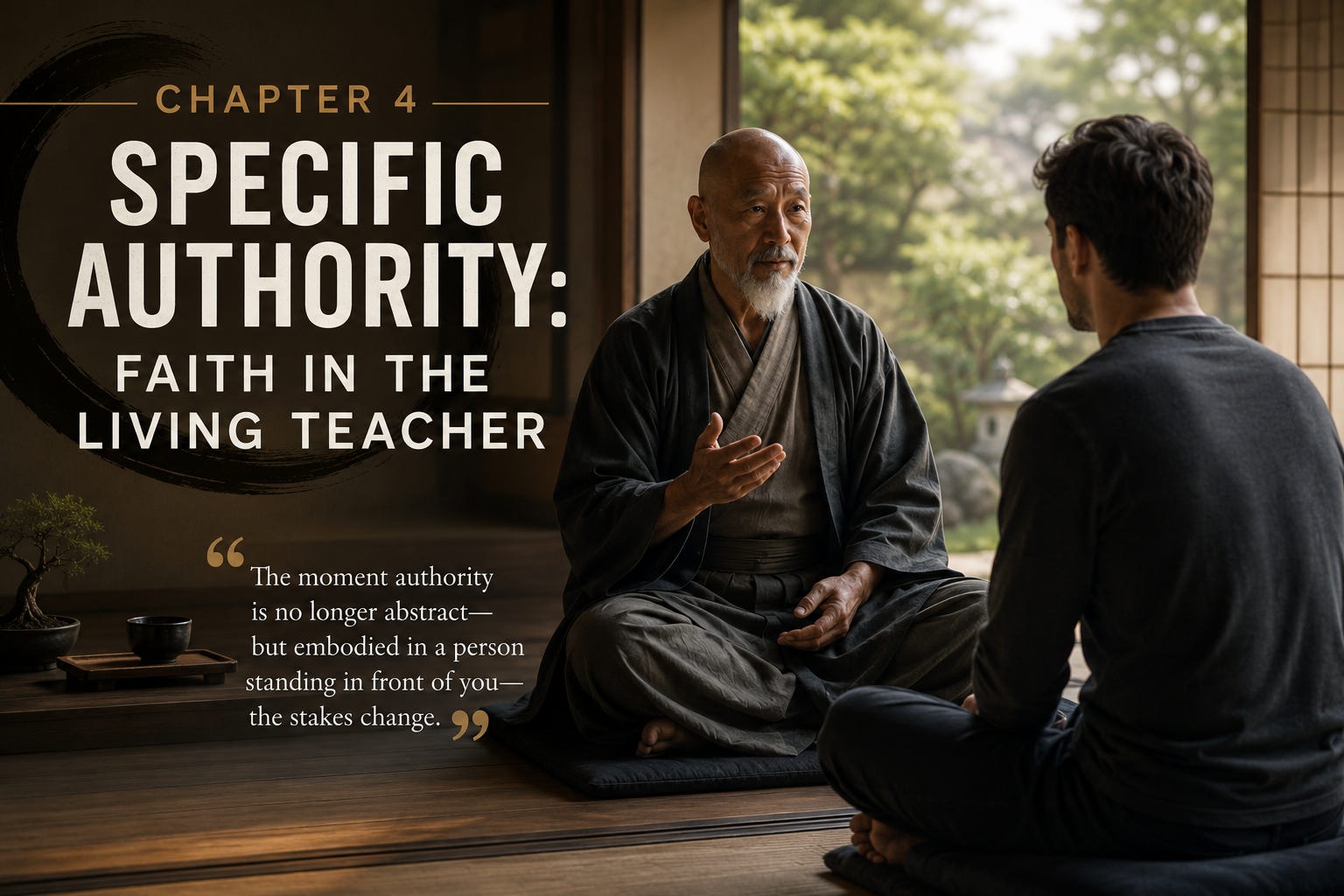
When Faith Gets Personal
From Scripture to the Living Teacher
Most discussions of faith begin with belief.
But what if faith is not primarily about belief at all?
What if faith is the activity of assigning authority in response to uncertainty?
In the early stages of a spiritual journey, that authority is often assigned to traditions, scriptures, and historical figures. We look to the wisdom of the past because we are unsure of how to proceed in the present.
But eventually, many seekers encounter something that history cannot provide: a living teacher.
A book cannot answer your question.
A scripture cannot recognize your blind spots.
A teacher can.
This is the central theme of Chapter 4 of The Last Turtle: Zero, Zen, and the Culmination of Faith. The chapter explores the transition from general authority to specific authority—from trusting teachings to trusting the person who embodies them.
At first glance, this seems like a natural progression. A living teacher can adapt instruction to the student, challenge misunderstandings, and provide guidance that is impossible to find in a static text.
Yet the relationship introduces new dangers.
The closer authority becomes, the easier it is to project qualities onto it. Students may begin to see the teacher not as a human being, but as a symbol of perfection. They may mistake guidance for infallibility, or trust for dependency.
This is not merely a problem in Zen. It appears throughout the history of religion, philosophy, and even modern self-help movements.
The challenge is subtle.
How do we learn from someone without surrendering ourselves to them?
How do we trust a teacher without becoming dependent upon them?
The answer may lie in recognizing the true purpose of the teacher-student relationship.
A genuine teacher does not seek followers.
A genuine teacher seeks to cultivate independence.
The teacher functions as a temporary embodiment of authority—a living reference point that helps the student navigate uncertainty. But if the relationship is successful, the authority once assigned outward gradually becomes internalized.
What first appeared to belong exclusively to the teacher begins to emerge within the student.
In that sense, the highest purpose of the teacher is not to stand between the student and reality.
It is to remove themselves from that position.
The greatest teachers do not create lifelong dependence.
They create people capable of seeing clearly for themselves.
In this short audio excerpt, we explore why faith becomes both more powerful and more dangerous when authority takes on a human face—and why the ultimate goal of the teacher may be to help students discover that what they were seeking was never entirely outside themselves.
The Last Turtle: Zero, Zen, and the Culmination of Faith examines faith not as a set of beliefs, but as a dynamic activity that shapes how human beings respond to uncertainty, authority, and the search for understanding.


