
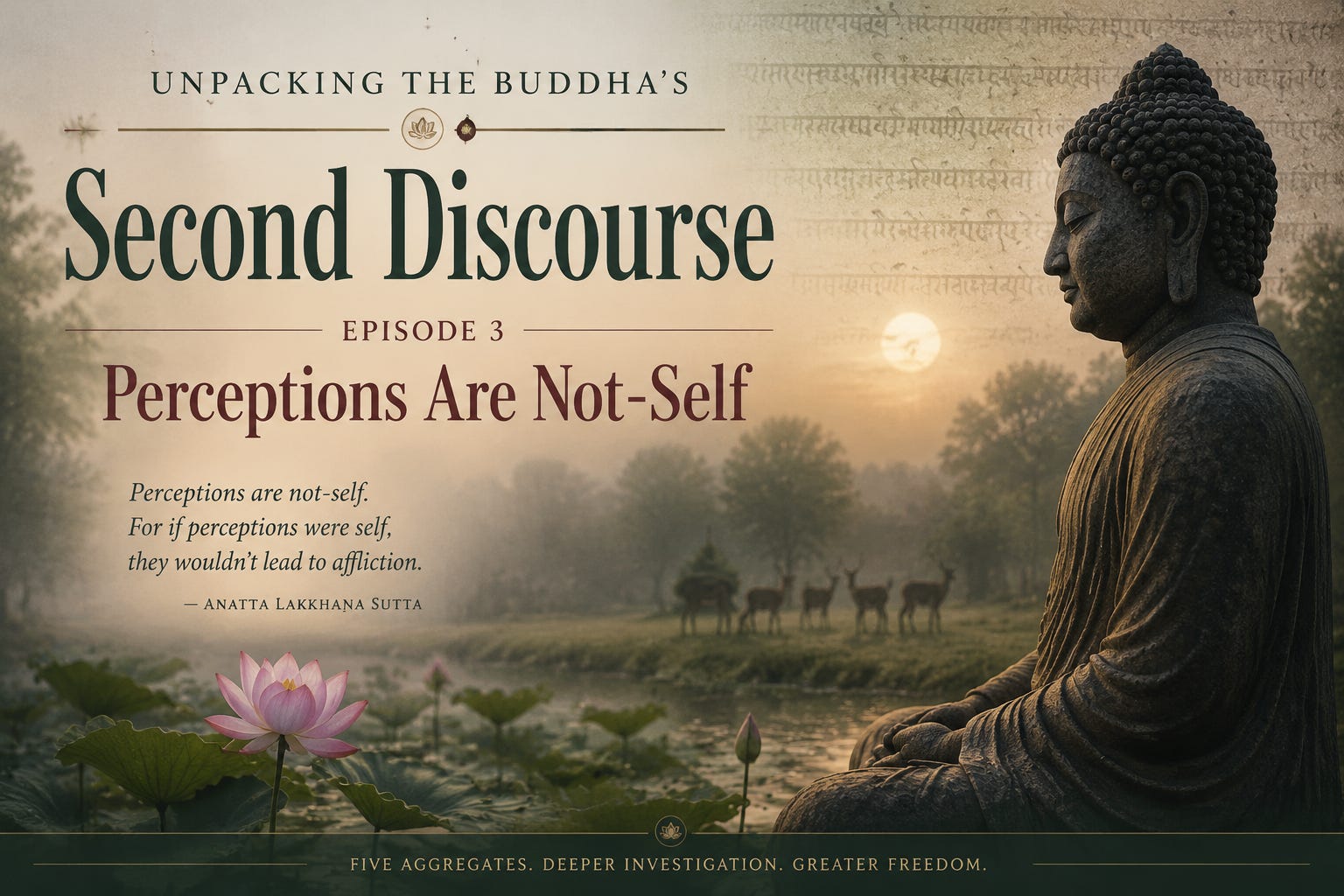
Perceptions Are Not-Self: Unpacking the Buddha’s Second Discourse — Episode 3
The Buddha’s second discourse, traditionally known as the Anattalakkhaṇa Sutta or “The Discourse on the Characteristic of Not-Self,” is often summarized with a single phrase: “the five aggregates are not-self.”
But such a summary risks overlooking the depth of the teaching.
The Buddha was not simply making a philosophical claim about what the self is or is not. He was pointing directly at the mechanisms through which suffering arises. To understand this teaching, we must examine it carefully—sentence by sentence, term by term, and sometimes word by word.
This is what we mean by “unpacking.”
Not all practitioners have the opportunity to regularly engage with a living teacher. In the Zen tradition, it is this direct engagement—the meeting between teacher and student—that often substitutes for the critical examination of traditional texts. But when that opportunity is absent, we must return to the texts themselves and approach them as teachers.
And like any good teacher, the texts do not simply provide answers. They present riddles. They present challenges. They present landmines that must be carefully cleared if we are to make genuine progress.
In this episode, we turn our attention to the third of the five aggregates: perception.
The Buddha says:
“Perceptions are not-self.”
At first glance, this statement seems simple. But what exactly does it mean?
There is an important distinction between saying:
“Perceptions are not-self.”
and saying:
“Perceptions are not self.”
The first suggests that perceptions do not possess the qualities of an independent, permanent self. The second suggests that perceptions are something other than the self.
The Buddha’s teaching points toward something deeper.
If perceptions truly were self, then they would not lead to affliction. If they were something we fully controlled, we could command them:
“May my perceptions be like this. May they not be like that.”
But experience tells us otherwise.
Perceptions arise.
They change.
They disappear.
We do not simply choose what appears meaningful, what appears threatening, what appears beautiful, or what appears unpleasant. We cannot command perception to conform perfectly to our desires.
And this inability to control perception reveals something fundamental: perception is not owned by a separate self.
This is the same reasoning the Buddha applies throughout the five aggregates.
If something were truly self, we should be able to exercise complete authority over it. We should be able to say:
“Let it be this way.”
“Do not let it be that way.”
But when we examine our experience honestly, we discover that the things we most instinctively identify as “me” or “mine” are precisely the things that escape our control.
Perception is a perfect example.
A person may perceive an insult where another perceives a joke. One person may see opportunity where another sees danger. One person may experience beauty where another experiences indifference.
Perceptions are shaped by conditions.
They arise through experience, memory, context, and countless influences beyond our direct control.
And because we mistake these changing perceptions for something belonging to a permanent self, suffering follows.
The problem is not that perception exists.
The problem is the attachment:
“This is my perception.”
“This is how things truly are.”
“This must remain this way.”
From there, affliction naturally follows.
The Buddha’s teaching challenges one of our deepest assumptions: that there is an enduring owner behind experience—a self that possesses perceptions, feelings, thoughts, and intentions.
But when we look closely, we find only the activity itself.
There is seeing.
There is hearing.
There is recognizing.
There is interpreting.
There is perceiving.
But where is the separate perceiver?
This investigation does not eliminate perception. It does not deny the reality of experience. Instead, it reveals the mistaken assumption that behind experience there must be a permanent self controlling it.
And this insight extends beyond perception.
If perceptions are not-self, then we must also examine the other aggregates:
Form.
Consciousness.
Feeling.
Volitional formations.
Are these truly self?
Can they be commanded?
Can they be made to remain exactly as we wish?
The Buddha’s second discourse invites us into this investigation—not as an abstract philosophical exercise, but as a direct examination of the source of suffering itself.
The question is not merely:
“What am I?”
The deeper question is:
“What am I claiming ownership over that was never truly mine?”
As we continue unpacking the Buddha’s second discourse, we will continue examining these aggregates—not as concepts to believe, but as experiences to investigate.
Because the path to freedom begins with seeing clearly.


