
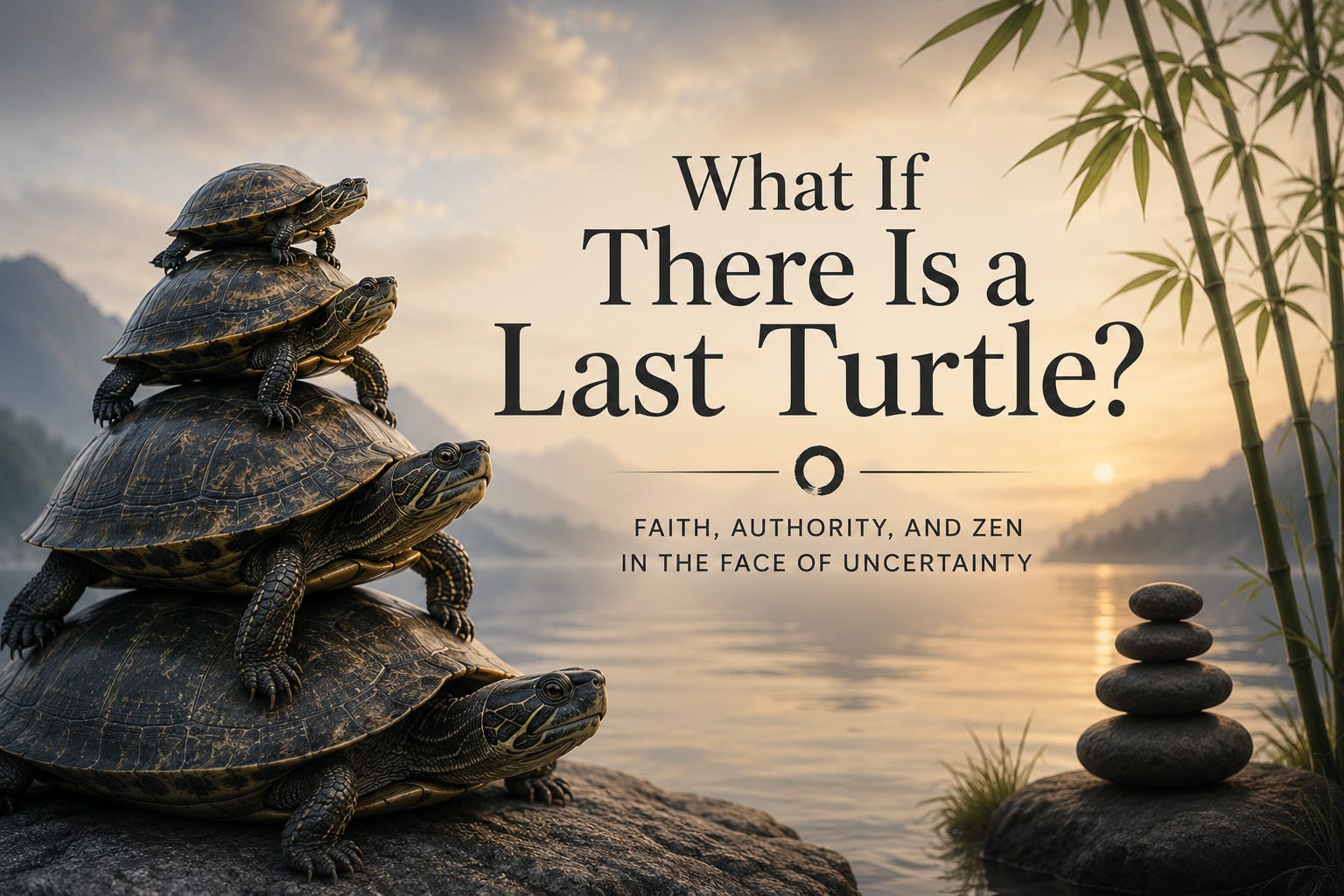
What If There Is a Last Turtle?
“It’s turtles all the way down.”
The old expression describes a wonderfully absurd problem.
The world rests on the back of a turtle.
Fine.
But what does that turtle rest on?
Another turtle.
And that turtle?
Another.
Keep asking long enough and apparently you never reach the bottom.
Zen can sometimes feel remarkably similar.
Ask what Zen is, and you may be given a teaching.
Ask what supports that teaching, and you may be given another.
Keep asking and eventually you may encounter some version of: concepts are traps, reality cannot be captured in words, explanations have limits, and perhaps you should stop asking so many questions and simply sit.
There is certainly wisdom in recognizing the limitations of conceptual thought.
But there is another possibility worth considering:
What if there is a last turtle?
Not a final metaphysical explanation of the universe.
Not an ultimate doctrine we are required to believe.
But a functional ground from which we can begin examining what Zen actually does.
Zero
The late Zen master Joshu Sasaki taught what I refer to throughout The Last Turtle as the teachings of Zero.
At their simplest:
From Zero, all activity inevitably arises.
And all activity inevitably returns to Zero.
Look closely and the pattern is everywhere.
A thought arises.
An emotion arises.
An intention arises.
A sense of “I am” arises.
Each manifests for some period of time—and each inevitably disappears.
Seen this way, Zero is not simply another Zen teaching to place on top of the philosophical stack.
It offers a way of examining the stack itself.
And once we begin looking at Zen as activity, something else becomes interesting.
Faith is activity, too.
What Is Faith?
Faith is commonly placed on the opposite side of reason.
Reason takes us as far as evidence and logic permit.
Then, supposedly, faith takes over.
Where knowledge ends, belief begins.
But this treats faith primarily as something we believe.
There may be a more practical way to understand it:
Faith is the activity of assigning authority in the face of uncertainty.
We do this constantly.
We assign authority to physicians because we cannot independently verify all of medical science.
We assign authority to engineers when we drive across bridges we did not design.
We assign authority to teachers when we begin learning something we do not yet understand.
And in spiritual practice, we may assign authority to traditions, scriptures, lineages, teachers, methods, and interpretations.
The question, then, is not simply:
“Do you have faith?”
A more useful question may be:
To what are you assigning authority—and why?
Faith as Appeal to Authority
“Appeal to authority” is often discussed as though it were inherently a logical mistake.
But practically speaking, some appeal to authority is unavoidable.
You cannot learn something new without temporarily accepting guidance from someone or something that presumably knows what you do not.
The real problem is not assigning authority.
The problem is assigning it without examining what follows.
Who—or what—are you trusting?
Why?
What evidence supports that trust?
What happens when you follow that authority?
And perhaps most importantly:
When should that authority be reconsidered?
Zen makes this question particularly interesting because authority does not necessarily remain where it began.
A practitioner may begin by trusting Buddhism generally.
Then a particular Zen tradition.
Then a particular teacher.
Then a particular practice.
As understanding changes, the assignment of authority changes with it.
Faith evolves.
And if the process continues far enough, faith eventually manifests as practice—and ultimately as what we will later call manifesting the norm.
Faith has not simply disappeared.
Its function has changed.
The Map Is Not the Journey
A book naturally presents ideas in a sequence.
Chapter follows chapter.
One concept leads logically to another.
Faith leads to practice.
Practice leads somewhere else.
Everything appears wonderfully orderly.
But nobody actually experiences Zen that way.
The lived journey is much messier.
We trust.
Then doubt.
Understand.
Then misunderstand.
Think we have finally figured something out.
Then discover that what we understood was incomplete.
We may adopt a framework, abandon it, and return years later with an entirely different understanding of what it was trying to say.
This is important to remember while reading The Last Turtle.
The book necessarily presents a logical, linear description of Zen and faith.
Your experience probably will not be logical or linear.
It will more likely be a persistent adjustment to your own understanding.
And that adjustment is not a detour from the journey.
It is the journey.
Zen is not a recipe.
It is an activity.
Finding the Last Turtle
The title The Last Turtle points toward the central question underlying the book.
How far down can we go?
If a Zen teaching rests upon another teaching, and that teaching rests upon another conceptual framework, do we eventually reach something foundational?
The teachings of Zero suggest that we do.
Not a final belief.
Not an unquestionable doctrine.
Not a metaphysical answer to everything.
A functional ground.
Activity arises.
Activity manifests.
Activity disappears.
That simple observation gives us a different way to examine Zen, the self, practice—and eventually faith itself.
The purpose is not to find something new to believe.
It is to understand what is actually happening.
Perhaps that is the more interesting possibility hidden inside the old turtle story.
Maybe the answer was never “turtles all the way down.”
Maybe, eventually, there is a last turtle.
And maybe the real journey begins when we ask what lies beneath it.


