
What Is Faith?
What if faith has almost nothing to do with belief?
That may sound like a strange question. After all, faith and belief are so commonly treated as synonyms that separating them can seem unnecessary.
But consider what actually happens when we encounter uncertainty.
We do not know what will happen.
We do not have enough information.
We cannot personally verify every fact, investigate every possibility, or predict every outcome.
And yet, we still have to act.
So what do we do?
We assign authority.
We trust the doctor.
We follow the teacher.
We accept the conclusions of the scientist.
We rely on a religious tradition, a philosophical framework, our own reasoning, or our past experience.
And then we move forward.
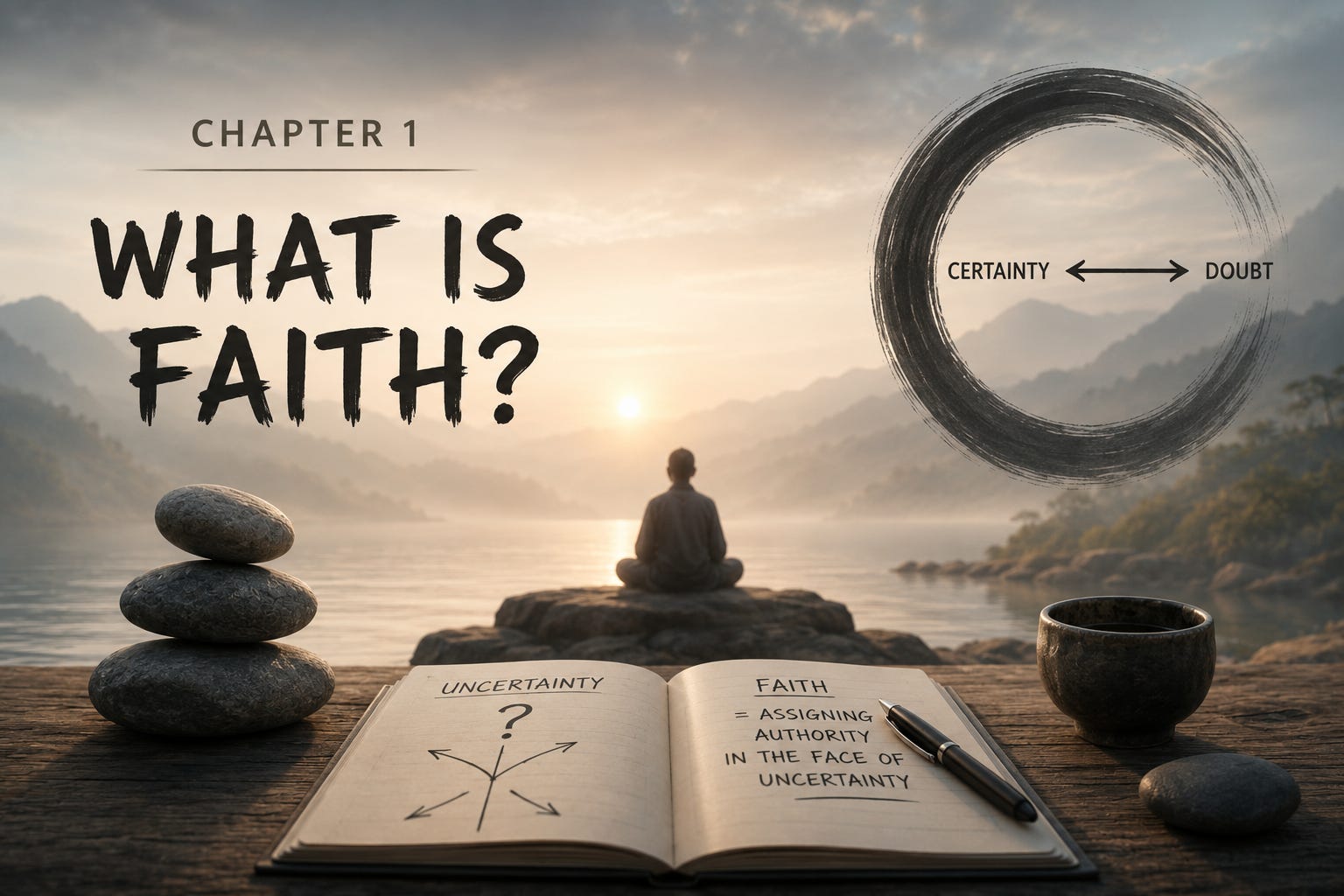
This suggests a very different definition of faith:
Faith is not belief in what lies beyond reason.
Faith is the activity of assigning authority in the face of uncertainty.
That definition changes the discussion considerably.
Because faith is no longer something possessed only by religious people.
Everyone has faith.
The atheist has faith.
The scientist has faith.
The skeptic has faith.
The Zen student has faith.
The question is not whether we assign authority.
We do it constantly.
The more interesting question is:
Where do we assign it?
And why?
Between Certainty and Doubt
Faith becomes necessary because human beings live somewhere between certainty and doubt.
If we possessed absolute certainty, faith would be unnecessary.
We would simply know.
But absolute certainty is rare.
At the other extreme lies complete doubt.
If we doubted everything equally, action would become nearly impossible. We would have no basis for choosing one course over another.
Faith occupies the territory between the two.
We do not know.
But we must act anyway.
So we assign authority.
Sometimes to another person.
Sometimes to an institution.
Sometimes to a text.
Sometimes to reason.
Sometimes to our own experience.
Seen this way, faith is not an intellectual weakness.
It is a practical necessity.
The difficulty is that assigning authority does not guarantee that we have assigned it wisely.
And that is where things become interesting.
The Problem With Belief
Defining faith as belief can hide the most important part of the process.
A belief can simply sit there.
We can claim to believe something without allowing it to affect our lives in any meaningful way.
But assigning authority is different.
Authority changes behavior.
If I assign authority to a doctor, I may take the prescribed medicine.
If I assign authority to a teacher, I may follow the teacher’s instructions.
If I assign authority to reason, I may reject a conclusion that appears unsupported.
If I assign authority to my own direct experience, I may question ideas that I previously accepted without hesitation.
Faith, understood this way, is not primarily about what we say we believe.
It is revealed by what we actually rely upon.
The Problem of Double Vision
But there is another complication.
We experience our lives with something like double vision.
First, there is the immediate experience itself.
Something happens.
We see.
We hear.
We feel.
We act.
And then there is the second view.
We look back.
We remember.
We analyze.
We interpret.
We explain what happened.
The experience and the explanation are not necessarily the same thing.
A person may have a powerful experience during meditation and later interpret it as enlightenment.
Another person may interpret the same experience as a temporary psychological state.
A religious believer might call an unexpected event divine intervention.
A skeptic might call it coincidence.
The event occurred first.
The explanation came later.
This is the double vision that complicates any serious discussion of faith.
We have the experience.
And then we have the story we tell about the experience.
The two can become so intertwined that we eventually forget there was ever a difference.
Faith as an Activity
This is why faith may be better understood as an activity rather than a possession.
We assign authority.
We act.
Something happens.
We look back.
We interpret what happened.
And then, whether we realize it or not, we adjust where authority will be assigned the next time.
Faith becomes a continuing process.
A feedback loop.
Authority.
Action.
Experience.
Interpretation.
Adjustment.
And then the process begins again.
This also gives doubt an important role.
Doubt is not necessarily the enemy of faith.
Doubt can be the mechanism by which faith is corrected.
Without doubt, authority can harden into dogma.
But without faith, doubt can prevent action altogether.
The challenge is not to eliminate one in favor of the other.
The challenge is learning how to live between them.
So, What Is Faith?
The opening chapter of The Last Turtle: Zero, Zen, and the Culmination of Faith begins with a deceptively simple question:
What is faith?
The answer proposed here is equally simple:
Faith is the activity of assigning authority in the face of uncertainty.
But that definition immediately raises another series of questions.
Where does authority begin?
Why do we trust one person rather than another?
What happens when reason challenges tradition?
What happens when direct experience challenges reason?
Can authority eventually move from the teacher to the student?
And what happens when we discover that even our own interpretations cannot provide absolute certainty?
These are not questions about what we should believe.
They are questions about what human beings actually do.
We encounter uncertainty.
We assign authority.
We act.
We experience the consequences.
And then, looking backward through the second lens of our double vision, we try to understand what just happened.
The audio narration accompanying this post presents Chapter 1, “What Is Faith?”
It begins with belief.
But the larger journey is about authority.
And about what happens when, despite all our uncertainty, we must decide where to place it.


