
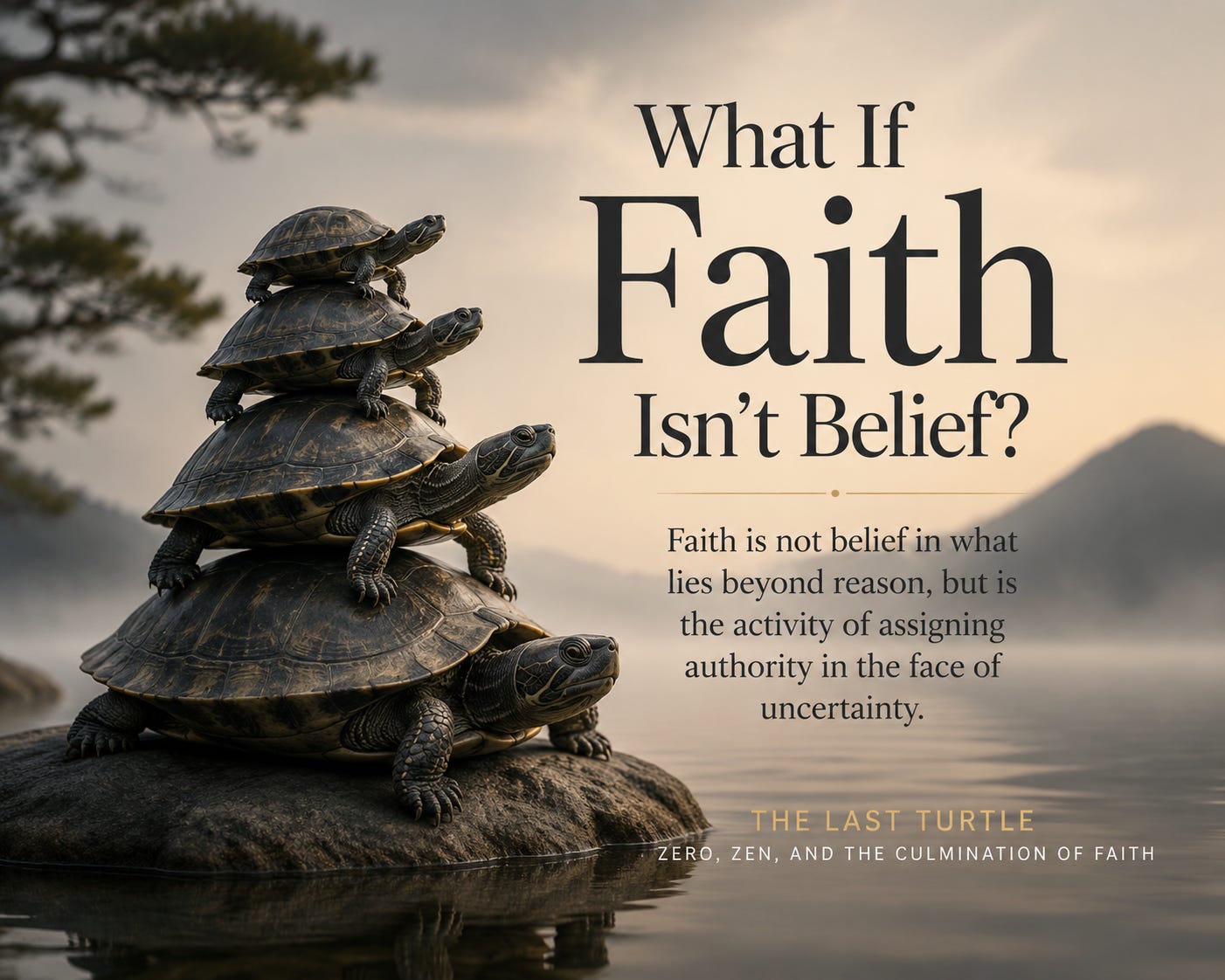
What If Faith Isn’t Belief?
Most discussions of faith begin with belief.
Believe in a doctrine.
Believe in a teacher.
Believe in something that cannot be proven.
But what if we’ve been asking the wrong question?
What if faith isn’t primarily about what you believe at all?
The introduction to my book, The Last Turtle: Zero, Zen, and the Culmination of Faith, explores a different possibility: that faith is not belief beyond reason, but the activity of assigning authority in the face of uncertainty.
Think about it for a moment.
Every day we make decisions without possessing complete knowledge. We trust physicians whose research we have not personally verified. We drive across bridges we did not engineer. We follow GPS directions through unfamiliar cities. We accept the findings of scientists, historians, and teachers because we cannot independently rediscover everything humanity has learned.
This is not irrational. It is unavoidable.
The real question is not whether we exercise faith.
The question is where we assign our authority.
Zen presents a fascinating case study because it begins with external authority—a teacher, a tradition, a method—but ultimately aims toward something entirely different. If the practice succeeds, authority gradually shifts away from books, teachers, and institutions toward direct experience itself.
That journey is rarely as tidy as books make it appear.
One purpose of writing is to create logical maps. Chapters naturally proceed from one idea to the next, each concept building upon the previous one. Reality, however, has little interest in chapter headings.
Our own practice tends to move in circles rather than straight lines. We become convinced, then uncertain. We discover clarity, only to question it later. We return to ideas we thought we had already understood, finding entirely new meanings years after first encountering them.
Far from being evidence of failure, this constant recalibration may be the very mechanism through which understanding matures.
The teachings of Zero, developed by the late Zen master Joshu Sasaki and explored throughout this book, provide a foundation for understanding this movement. Rather than presenting another philosophical framework, Zero offers a way of describing activity itself: how experiences arise, stabilize, and inevitably disappear.
Seen from this perspective, Zen becomes less about collecting profound ideas and more about recognizing recurring patterns.
The goal is not to accumulate beliefs.
The goal is to see clearly.
And perhaps that is why the title The Last Turtle feels so appropriate.
We’ve all heard the old story of “turtles all the way down”—the suggestion that every explanation simply rests upon another explanation without end. Zen is sometimes portrayed in much the same way, where every sincere question is answered with another paradox, another koan, or another reminder that words ultimately fail.
I have never found that response entirely satisfying.
If Zen consistently produces greater clarity, compassion, and freedom from suffering, then something real must be happening. Whatever that “something” is deserves careful examination.
Not blind acceptance.
Not blind skepticism.
Careful examination.
That is the spirit in which this book is written.
If you’ve ever wondered why Zen emphasizes teachers, why practice matters more than philosophy, why reason eventually reaches its limits without becoming irrelevant, or why faith may have far more to do with everyday decision-making than supernatural belief, I hope you’ll enjoy this introduction.
Sometimes the most important questions aren’t answered by adding another turtle.
Sometimes they’re answered by discovering the ground beneath them.


