
Decide for Yourself: The Three Anchors — Movement, Awareness, and Spirit
Most Zen students eventually encounter a peculiar problem.
They are told to “be present.”
They understand the words. They agree with the principle. They may even dedicate years of their lives to meditation practice.
And yet, the instruction remains strangely elusive.
The moment they attempt to be present, they discover that they are thinking about being present.
The mind immediately transforms the present moment into an idea.
This is not a failure of practice. It is simply what the mind does.
The solution offered by Zen is not to suppress thought, nor to wage war against distraction. Instead, Zen provides anchors—points of contact with immediate experience that allow awareness to return naturally to the reality of this moment.
Most practitioners are familiar with the breath as such an anchor. But the breath is not the only one.
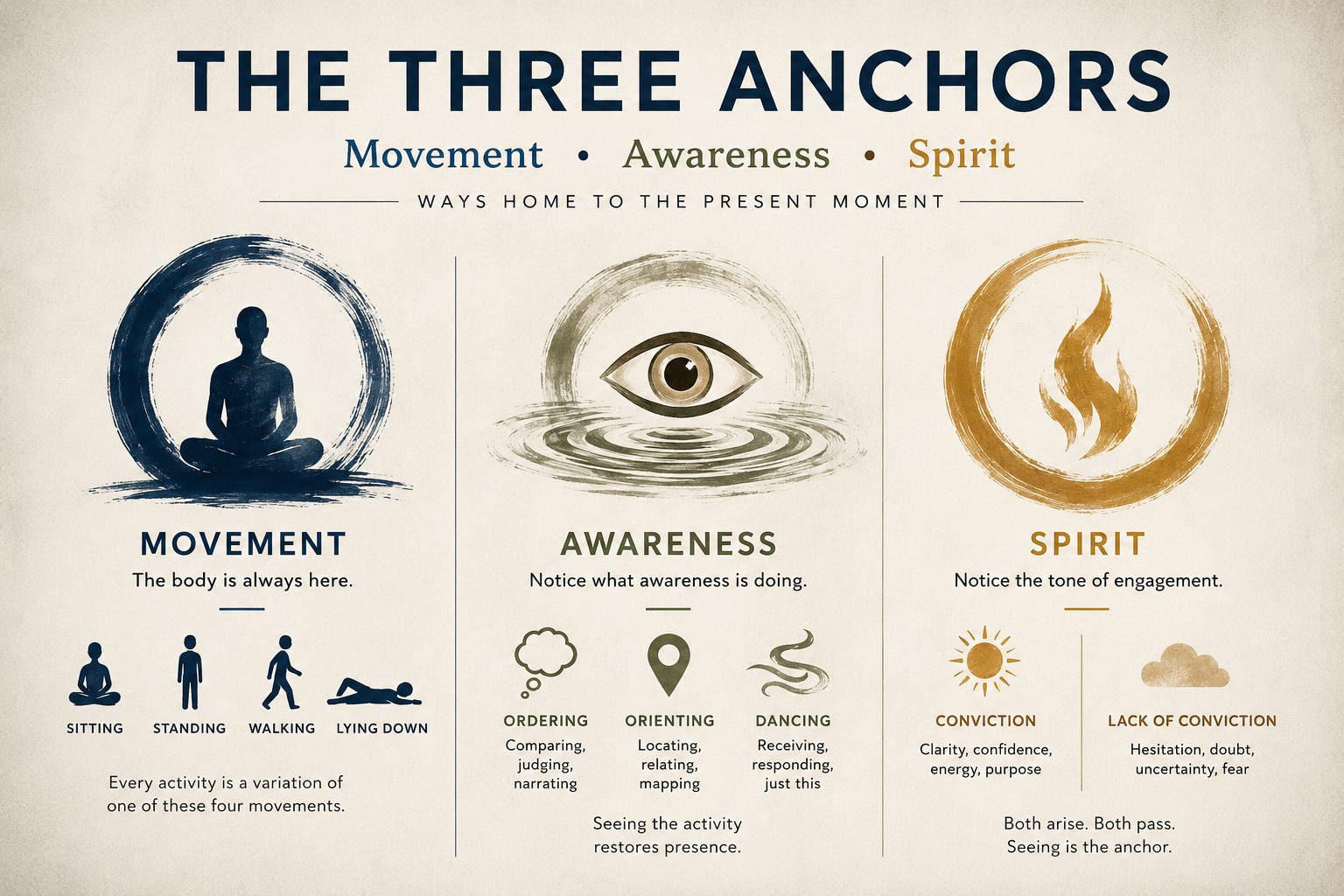
There are at least three powerful anchors available at all times: Movement, Awareness, and Spirit.
Anchor One: Movement
The Buddha frequently emphasized four fundamental movements: sitting, standing, walking, and lying down.
At first glance, this seems almost too simple to be useful.
Yet consider the possibility that every physical activity you perform is ultimately a variation of one of these four movements.
Reading this article? Sitting or standing.
Walking the dog? Walking.
Taking a nap? Lying down.
These movements are so familiar that we rarely notice them.
But this familiarity is precisely what makes them effective anchors.
When you genuinely recognize, “I am sitting,” attention immediately returns to the body. The mind may continue producing thoughts, but awareness is no longer completely absorbed in them.
The body becomes a reminder that reality is occurring here, not in memory and not in anticipation.
Movement is particularly valuable because it never leaves the present moment.
The body cannot exist tomorrow.
It cannot exist yesterday.
It can only exist now.
Anchor Two: Awareness
The second anchor is subtler.
Awareness itself can be understood as manifesting through three fundamental activities: ordering, orienting, and dancing.
Ordering is the activity of relating ideas to one another.
It is comparison, analysis, judgment, categorization, and interpretation.
Ordering is what allows us to think.
Orienting is different.
Orienting establishes relationships between ourselves and objects.
Where am I?
What is that sound?
What is happening around me?
It is the awareness that maps our place in the world.
Then there is dancing.
Dancing is what remains when ordering and orienting temporarily disappear.
Awareness is no longer organizing concepts or locating objects.
It is simply receiving.
Simply participating.
Simply responding.
The utility of this framework is that it gives practitioners something concrete to observe.
Instead of asking, “Am I present?”
One can ask:
“What is awareness doing right now?”
Is it ordering?
Is it orienting?
Or has it relaxed into dancing?
The very act of asking reawakens attention.
Anchor Three: Spirit
The third anchor is perhaps the most overlooked.
Spirit is often discussed in mystical language, making it difficult to use as a practical tool.
But spirit can be approached much more simply.
Think of spirit as the tone with which you meet the moment.
Sometimes there is conviction.
A sense of confidence.
Purpose.
Energy.
Readiness.
At other times there is hesitation.
Doubt.
Uncertainty.
A lack of conviction.
Neither condition is permanent.
Neither condition is wrong.
Both arise and disappear according to circumstances.
The practice is not to manufacture conviction or eliminate uncertainty.
The practice is simply to notice.
“Ah. This is how spirit is manifesting right now.”
That recognition itself becomes an anchor.
The moment we become aware of our relationship to the moment, we have already returned to it.
Three Ways Home
The beauty of these anchors is their availability.
No meditation cushion is required.
No special environment is necessary.
No spiritual achievement must first be attained.
At any moment, you can ask:
What movement am I manifesting?
What activity of awareness is operating?
What is the quality of my spirit?
Each question redirects attention away from abstraction and toward experience.
And that is the essence of Zen practice.
Not the pursuit of extraordinary states.
Not the acquisition of esoteric knowledge.
Not the construction of a better self.
Simply the repeated rediscovery of what is already happening.
The breath remains a powerful anchor.
But it is not the only anchor.
Movement anchors us in the body.
Awareness anchors us in the functioning of the mind.
Spirit anchors us in our relationship to the moment.
Together, they form a practical framework for reawakening—again and again—to the only place where life is ever actually lived.
This moment.


