
Imagine spending years climbing a mountain only to discover that the summit is not the destination.
Now imagine that when you finally reach the top, your teacher looks at you and says, “Good. Take one more step.”
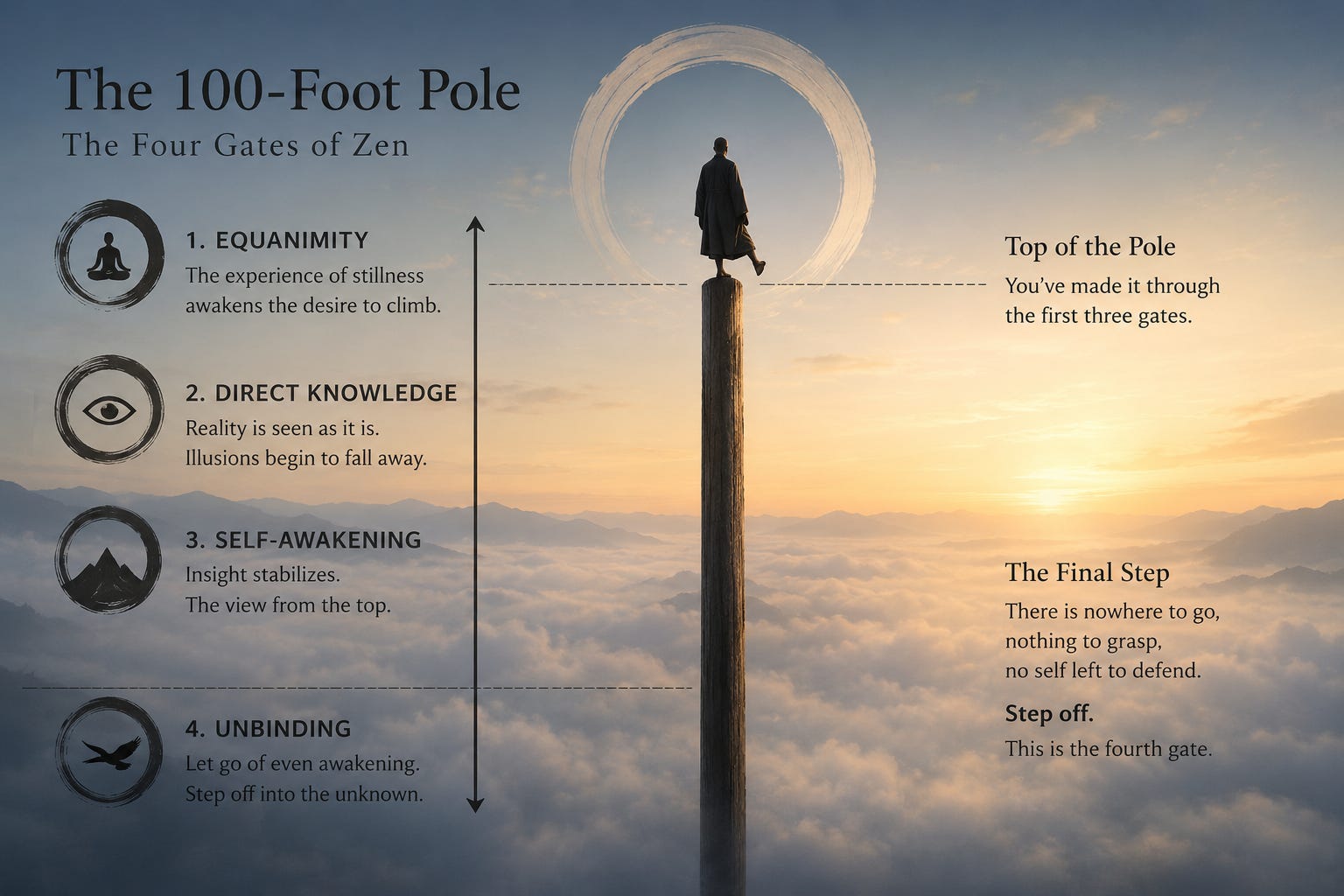
That is the essence of one of Zen’s most famous metaphors: the one-hundred-foot pole.
At first glance, the metaphor seems absurd. A practitioner climbs to the top of a towering pole and is then instructed to step forward. There is nowhere to go. No platform. No ladder. No safety net. Only empty space.
And yet, according to Zen, this final step is the most important one.
Why Climb at All?
The metaphor becomes especially interesting when viewed through the lens of the four Buddhist gates:
Equanimity
Direct Knowledge
Self-Awakening
Unbinding
The journey begins with equanimity.
Many people assume equanimity is merely emotional balance or calmness. But in practice, it often begins with a direct experience of stillness. Perhaps during meditation. Perhaps while walking in nature. Perhaps during an unexpected moment when the constant internal commentary simply falls silent.
For a brief moment, there is peace.
That taste of stillness becomes the motivating force for practice. Without it, why climb at all?
The practitioner senses that there is something worth exploring and begins the ascent.
Climbing the Pole
As the climb continues, the practitioner encounters the second gate: direct knowledge.
Ideas become observations.
Impermanence is no longer a philosophical concept but something directly experienced. The fluid nature of identity becomes increasingly obvious. Attachments, fears, and habits reveal themselves more clearly.
The higher the climb, the broader the view.
Eventually comes the third gate: self-awakening.
At this stage, insight is no longer occasional. Understanding begins to stabilize. One’s relationship with experience changes. The practitioner no longer merely studies the teachings but embodies them.
Reaching the top of the pole represents the culmination of these first three gates.
Equanimity motivated the climb.
Direct knowledge illuminated the path.
Self-awakening brought the practitioner to the summit.
Surely this is enlightenment.
Or is it?
The Final Trap
Zen is rarely interested in letting practitioners settle comfortably into their achievements.
The master looks up and says:
“Take one more step.”
This instruction points directly toward the fourth gate: unbinding.
The challenge is subtle.
Even awakening can become something to cling to.
Even insight can become an identity.
Even realization can become another possession.
The practitioner may no longer be attached to wealth, status, or opinion, yet remain attached to being awakened.
The pole itself becomes the final attachment.
And so the impossible instruction arrives.
Step off.
What Happens When You Let Go?
From the perspective of the ordinary mind, stepping off the pole appears catastrophic.
Everything that provided security disappears.
There is no longer a position to defend. No attainment to maintain. No identity to preserve.
Yet Zen suggests that what appears to be a fall is actually freedom.
The practitioner discovers that reality was never dependent upon the pole.
The pole was only a support structure.
Its purpose was never to become a permanent residence.
Its purpose was to prepare the practitioner for release.
The final step is not a rejection of practice. It is the fulfillment of practice.
The Pole in Everyday Life
Most of us will never stand atop a literal one-hundred-foot pole.
But we encounter the metaphor constantly.
We become attached to accomplishments, beliefs, identities, careers, relationships, and even spiritual insights. We climb toward them. We work for them. We define ourselves through them.
Then life asks us to take one more step.
To let go.
To move beyond certainty.
To trust what remains when our favorite stories about ourselves no longer hold together.
This is why the metaphor continues to resonate after centuries.
It is not really about a pole.
It is about the willingness to release the very thing that brought us this far.
The Zen path begins with a glimpse of stillness.
It continues through knowledge and awakening.
But according to the masters, the journey is not complete until there is the courage to step into open space.
And perhaps that is the greatest surprise of all.
The final step is not away from life.
It is directly into it.
In the Zen tradition, the one-hundred-foot pole reminds us that spiritual practice is not about finding a place to stand forever. It is about discovering the freedom to move when there is nowhere left to stand.


