
Most people think of bowing as a gesture of respect.
In Zen, it certainly can be. But if we stop there, we risk missing something important. Bowing is not merely a symbol. It is not simply a cultural artifact inherited from centuries of Buddhist tradition. Properly understood, bowing is practice.
The interesting question is not, “What does a bow mean?” but rather, “What happens while bowing?”
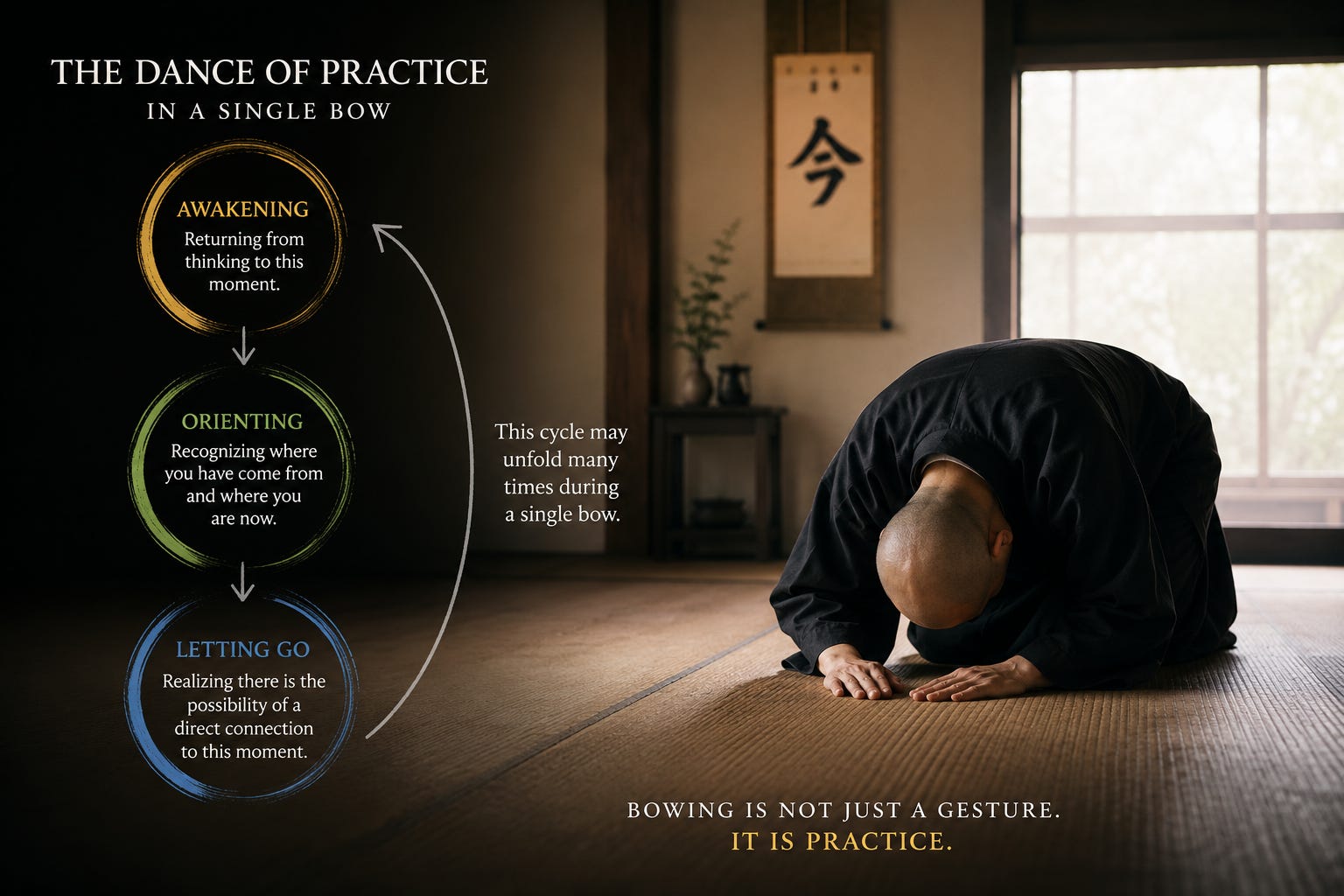
This week’s video explores bowing through the lens of three fundamental activities that appear throughout Zen practice: awakening, orienting, and letting go.
Awakening is the activity of returning from thinking to this moment.
Orienting is the activity of recognizing where you have come from and where you are now.
Letting go is the activity of realizing that there is the possibility of a direct connection to this moment.
These are not abstract philosophical ideas. They are activities that can be observed directly.
Consider a single bow.
Your hands come together. Almost immediately, the mind wanders. Perhaps a thought appears about posture. Perhaps a judgment arises. Perhaps there is a memory or anticipation. Then, suddenly, awareness returns to the physical experience of standing, breathing, and bowing.
That return is awakening.
A moment later comes orientation. You recognize that you had been caught in thought, and now you are present with the movement of the body. You recognize where you have come from and where you are now.
Then comes letting go. For an instant, there is no need to improve the bow, analyze the bow, or evaluate the bow. There is simply the bow itself.
And then the mind wanders again.
The remarkable thing is that this cycle does not occur once. It may occur many times during a single bow.
Awakening.
Orienting.
Letting go.
Then awakening again.
Orienting again.
Letting go again.
The deeper explanation is that practice is not linear. We often imagine Zen as a progression from point A to point B, as though one gradually accumulates enough understanding to finally arrive somewhere.
Actual practice feels much different.
It is cyclical.
It is repetitive.
It is immediate.
Each moment presents another opportunity to return from thinking. Another opportunity to recognize where we are. Another opportunity to discover that direct connection to this moment remains available.
This is why traditional Zen training includes activities that may appear mundane or ceremonial to outsiders. Bowing, chanting, walking meditation, cleaning, and eating are not distractions from practice. They are practice.
Every activity becomes an opportunity to awaken.
Every activity becomes an opportunity to orient.
Every activity becomes an opportunity to let go.
From this perspective, a bow is no longer merely a gesture performed before meditation begins. It becomes a complete expression of the path itself.
A single bow contains the entire practice.
Not because there is something magical about bowing, but because the opportunity to awaken, orient, and let go is always present.
The challenge is not finding the opportunity.
The challenge is noticing it.
In this week’s video, we explore how a simple bow can become a living laboratory for Zen practice and how the cycle of awakening, orienting, and letting go can unfold repeatedly within a single gesture.
Perhaps the next time you bow, you will discover that the movement is not merely a movement.
Perhaps you will discover a dance.
And perhaps, hidden within that dance, you will find this moment waiting for you.


