
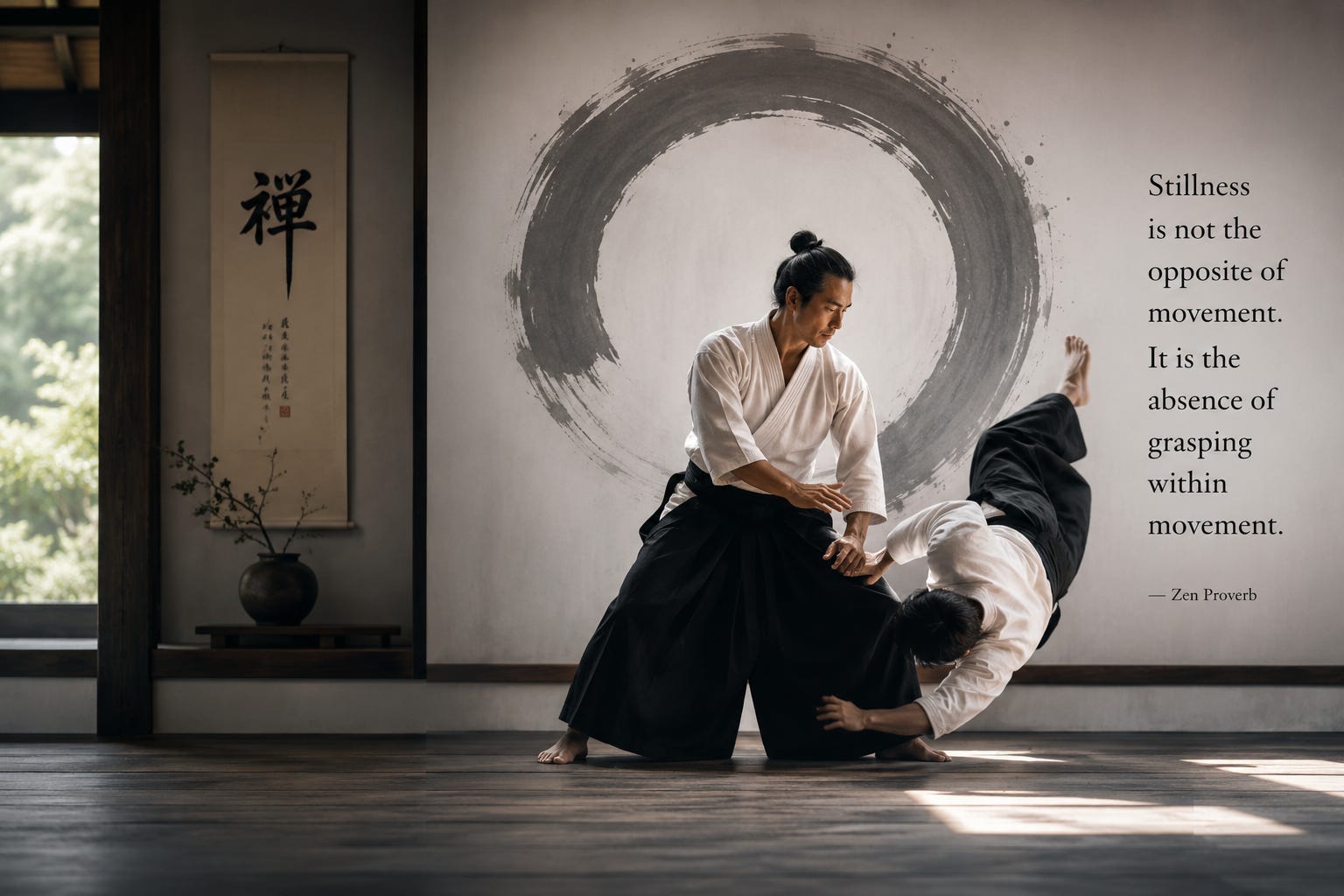
Zen and the Martial Way: Passing Through the First Zen Gate
Many people come to Zen expecting that stillness will be found by sitting quietly on a cushion.
This is understandable. The image of the motionless meditator is one of the most recognizable symbols of Zen. Yet there is an irony hidden within that image: some people discover stillness more readily while moving than while sitting.
This is one reason why the relationship between Zen and the martial arts has fascinated practitioners for centuries.
Not because martial arts are Zen.
Not because every black belt is secretly enlightened.
But because the disciplined practice of martial movement can provide a remarkably effective introduction to the first gate of the Zen path.
The First Gate
If we define the first gate of Zen as the experience of stillness—or what some traditions might call equanimity—then we are speaking of something very specific.
Stillness is not the absence of thought.
It is not emotional numbness.
It is not a trance.
And it is certainly not boredom.
Rather, stillness is the recognition that awareness remains present even when thoughts, emotions, and sensations are constantly changing. It is the realization that one need not be dragged around by every mental event that arises.
For many practitioners, this realization is the first unmistakable indication that Zen may be describing something real.
Before this experience, stillness is merely a concept.
Afterward, it becomes a possibility.
Why Martial Arts Work So Well
A beginner entering a dojo usually arrives with an entire collection of distractions.
They want to perform well.
They worry about failure.
They compare themselves to others.
They overthink techniques.
They anticipate mistakes.
In short, they bring exactly the same restless mind that appears on a meditation cushion.
The difference is that martial arts quickly expose the cost of this restlessness.
Overthinking slows reaction time.
Tension reduces efficiency.
Fear disrupts perception.
Self-consciousness interferes with movement.
The body becomes an uncompromising teacher.
A student who is trapped in thought cannot move effectively.
A student obsessed with winning often loses.
A student attempting to control every outcome discovers that reality refuses to cooperate.
And so, gradually, something begins to change.
The Exhaustion of the Ordinary Will
Hours become months.
Months become years.
The techniques become familiar.
Breathing becomes synchronized with movement.
The body learns what the mind has not yet fully understood.
The practitioner starts to discover that effective action emerges when unnecessary effort disappears.
The punch lands more cleanly when forced less.
The throw succeeds more readily when the practitioner stops trying to overpower the opponent.
The sword cuts more naturally when the body is allowed to move freely.
This is not magic.
It is simply the gradual elimination of interference.
And when enough interference falls away, stillness begins to reveal itself.
Not in spite of movement.
But through movement.
The Great Paradox
This is where the martial way and the Zen way begin to intersect.
The beginner assumes stillness and movement are opposites.
The experienced practitioner discovers they are not.
A martial artist engaged in a demanding exchange may experience a state in which awareness is completely present, yet remarkably calm.
The body moves.
The mind responds.
Action unfolds.
But the usual noise of self-commentary disappears.
There is no internal narrator announcing success or failure.
No running analysis.
No planning.
No hesitation.
Just direct engagement with the moment.
Zen practitioners often describe a similar experience during periods of deep practice.
The circumstances differ.
The stillness does not.
This is why so many martial artists become intrigued by Zen. They have already encountered one of its most important landmarks.
They simply discovered it while moving.
A Valuable Beginning
Yet an important distinction must be made.
Passing through the first gate is not enlightenment.
It is not awakening.
It is not the end of the journey.
It is the beginning.
The experience of stillness demonstrates that a different relationship with reality is possible. It reveals a freedom from ordinary reactivity that many people never suspect exists.
But Zen does not stop there.
Beyond stillness lie deeper investigations into the nature of self, awareness, attachment, and realization itself.
The martial arts can carry a practitioner to the threshold.
They can provide glimpses of extraordinary clarity.
They can reveal stillness hidden within movement.
But stepping beyond that threshold requires a different kind of inquiry.
The Gift of the Martial Way
Perhaps the greatest gift the martial arts offer is not self-defense, fitness, discipline, or confidence—valuable though all of those may be.
Perhaps their greatest gift is demonstrating that stillness is not confined to a meditation hall.
It can appear while walking.
While breathing.
While training.
While throwing a punch.
While receiving one.
It can emerge anywhere that grasping relaxes and awareness becomes unobstructed.
And once that stillness has been experienced, even briefly, something changes.
The practitioner begins to suspect that Zen is not about escaping activity.
It is about discovering what has always been present within it.
The dojo becomes more than a training hall.
It becomes a doorway.
And for some, that doorway opens directly onto the first Zen gate.


