
What if one of Buddhism’s deepest teachings wasn’t hidden in an ancient manuscript—but was visible almost every morning?
Long before sunrise, the morning star hangs low on the horizon. If you’ve ever watched it carefully, you’ve probably noticed something curious. It doesn’t simply shine. It flickers. It dances. It seems almost alive.
Yet wait another hour.
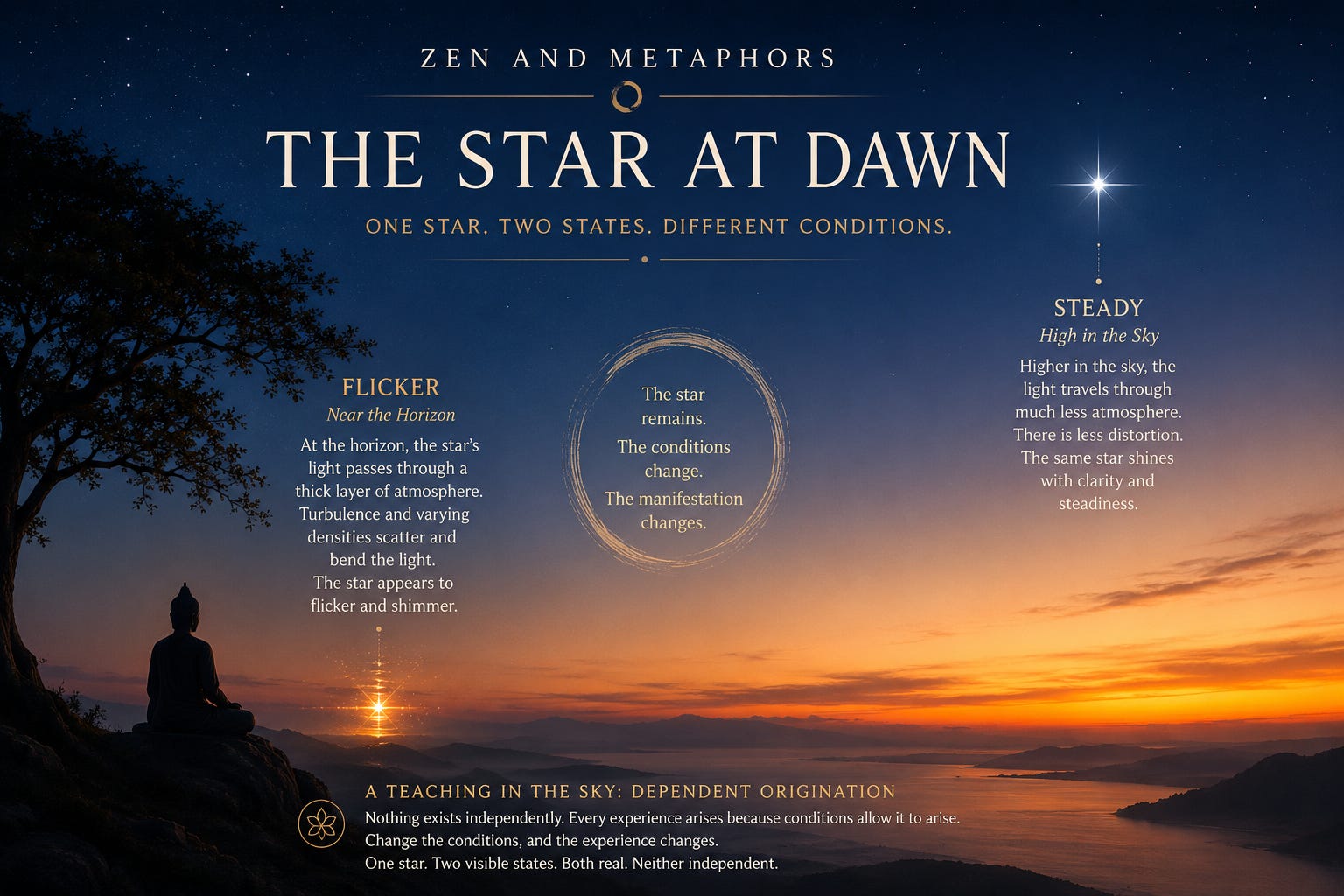
As the star climbs higher into the sky, the flickering disappears. The same star now shines with remarkable steadiness.
What changed?
Not the star.
The conditions.
Near the horizon, the star’s light must pass through a much thicker layer of Earth’s atmosphere. Countless variations in temperature and air density bend and scatter the light, creating the familiar shimmer astronomers call scintillation. Higher in the sky, where the light travels through much less atmosphere, the star appears calm and unwavering.
One star.
Two visible states.
The steady light and the flicker are not different stars. They are different manifestations of the same star under different conditions.
This simple observation provides a remarkably elegant metaphor for one of Buddhism’s most profound teachings: dependent origination.
The Buddha taught that nothing exists independently. Every experience, every perception, every emotion, every thought arises because conditions allow it to arise. Change the conditions, and the experience changes.
The morning star demonstrates this perfectly.
Its flicker is not contained within the star itself. The flicker emerges only through the interaction of the star, the atmosphere, the position of the Earth, the approaching dawn, and the observer. Remove any one of those conditions and the flicker changes—or disappears altogether.
The star remains.
The manifestation changes.
Traditional accounts tell us that the Buddha attained awakening upon seeing the morning star while seated beneath the Bodhi tree. Whether understood literally or symbolically, the image carries extraordinary depth.
Perhaps the Buddha was not simply seeing a bright object in the eastern sky.
Perhaps he was seeing reality itself.
The morning star reveals two complementary truths. The steady light reminds us that reality possesses a consistency beyond our changing perceptions. The flicker reminds us that every experience we have is conditioned, relational, and impermanent. Both are visible—just at different times.
Zen repeatedly points us toward this insight.
We often mistake the flicker for the thing itself. We mistake our shifting thoughts for a permanent self. We mistake our changing emotions for fixed realities. We mistake appearances for independent existence.
But the morning star quietly teaches otherwise.
The conditions shimmer.
Reality does not.
Perhaps this is why Zen so often turns to ordinary experiences rather than extraordinary ones. Awakening is not reserved for mountaintops or mystical visions. Sometimes it is waiting in something as familiar as the last bright star before sunrise.
The next time you’re awake before dawn, take a moment to look east.
Watch the morning star dance near the horizon.
Then watch it become still.
In those two moments, separated only by changing conditions, you may discover one of Buddhism’s oldest and most beautiful metaphors quietly unfolding above your head.


