
The Devas’ Cry: What If the Gods Were the First to Realize Everything Had Changed?
What happens when even the gods stop to pay attention?
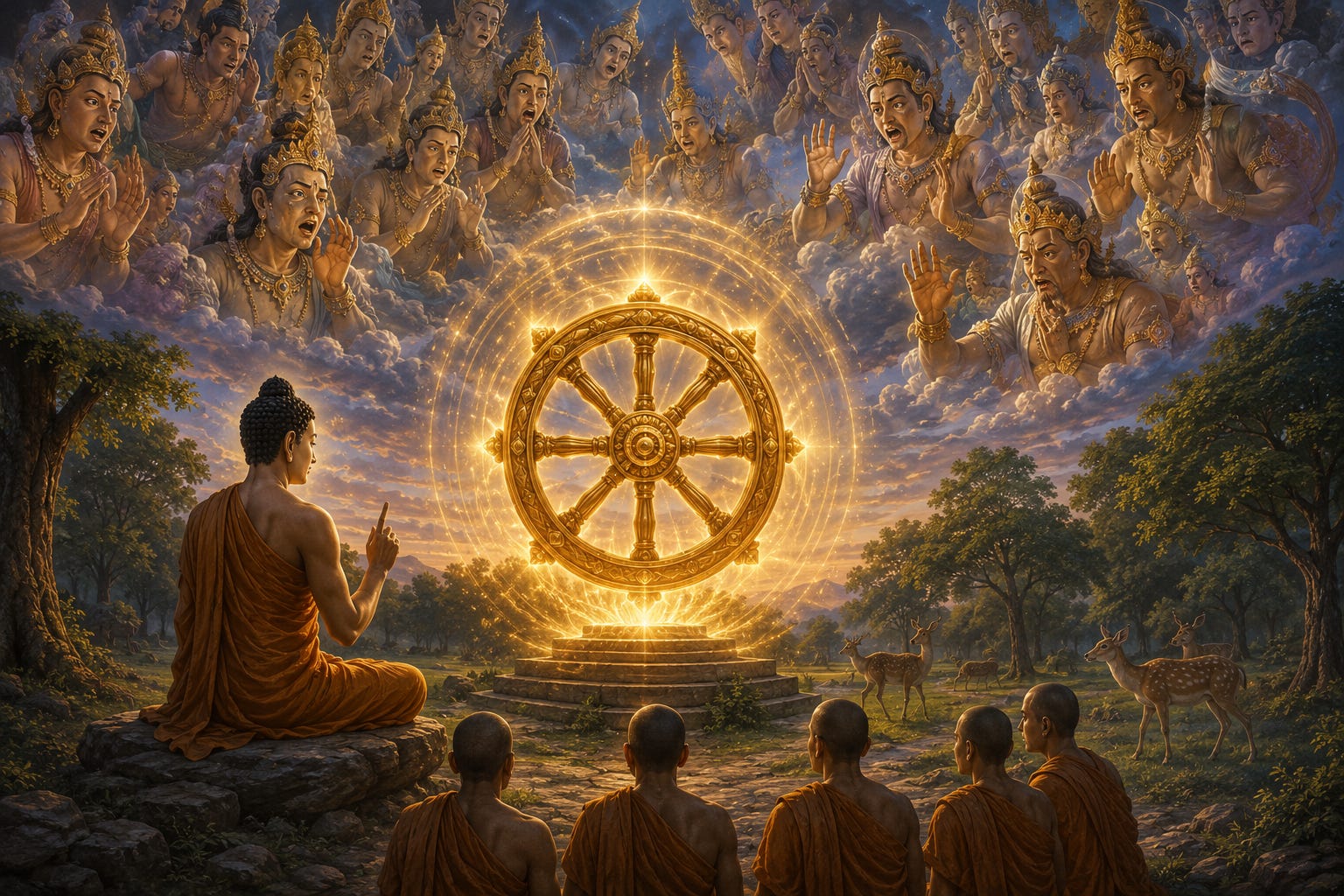
One of the most overlooked moments in the Buddha’s First Discourse occurs immediately after he sets the Wheel of the Dhamma in motion. According to the text, the earth-dwelling devas raise a cry, announcing that an unsurpassed teaching has entered the world—one that cannot be stopped by ascetics, brahmins, devas, Māra, Brahmā, or anyone else.
It’s a passage that many readers simply skim past.
But should we?
In the latest episode of Unpacking the Buddha’s First Discourse, we slow down and examine every phrase. As always, the goal isn’t merely to understand what the words say, but to uncover why those words were chosen in the first place.
The devas’ proclamation raises a fascinating possibility.
What if their cry isn’t simply one of celebration?
What if it also contains a recognition that the world has fundamentally changed—that humanity has been given something that no longer requires divine intermediaries?
If liberation can be realized through direct understanding of the Dhamma, then spiritual authority shifts dramatically. The Buddha is not introducing another deity to worship or another ritual to perform. Instead, he presents a path that ultimately depends upon investigation, realization, and the transformation of one’s own understanding.
Seen from that perspective, the devas’ announcement almost sounds like the acknowledgment of a changing era.
The old order hasn’t been destroyed.
It has simply been transcended.
This reading also helps explain why the sutta explicitly lists every conceivable source of spiritual authority—ascetics, brahmins, devas, Māra, and even Brahmā—as powerless to stop the Wheel once it begins to turn. The emphasis isn’t on defeating these beings. The emphasis is that truth, once discovered and properly taught, no longer depends upon any external authority for its continuation.
That is a remarkable claim.
Throughout this series, we’ve argued that the Buddha’s discourses are best approached not as collections of inspirational sayings but as carefully constructed puzzles. Every sentence deserves attention. Every phrase invites another question. Every apparent certainty conceals another layer waiting to be uncovered.
The devas’ cry is one of those layers.
It may be less about the gods themselves than about us—and about what becomes possible when ultimate authority shifts from external powers to direct realization.
Perhaps that is why this brief proclamation occupies such an important place in the discourse.
Sometimes the most revealing passages are also the shortest.
I hope you’ll join me as we continue unpacking the Buddha’s First Discourse, one phrase at a time.


