
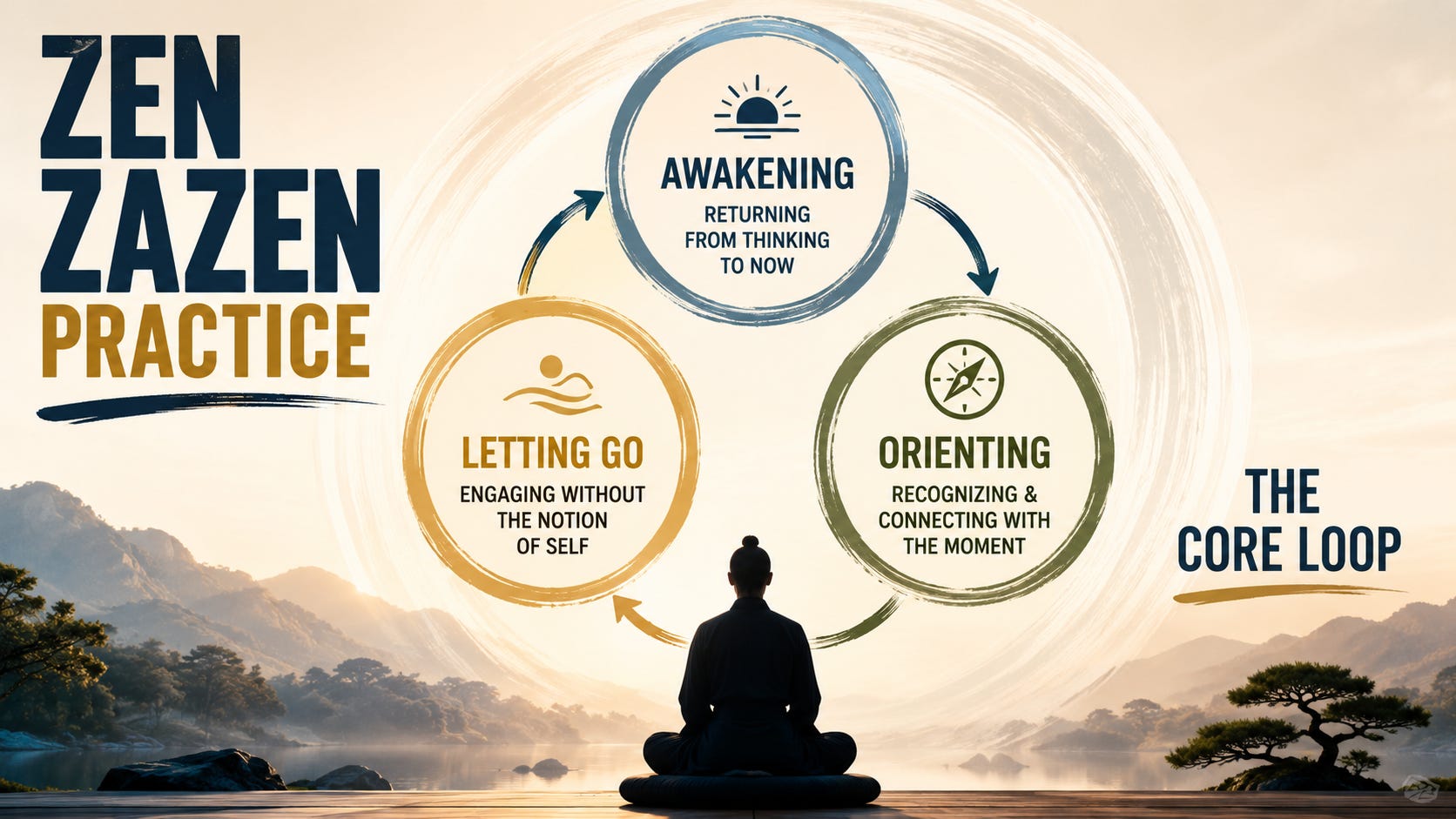
All Things Zazen: Common Core Practice
What if the most important part of meditation wasn’t staying focused… but realizing that you’ve lost focus?
That sounds almost ridiculous at first. After all, most people approach meditation as though success means achieving some uninterrupted state of perfect calm. The idealized image is clear enough: a serene monk, motionless as stone, floating in an ocean of endless awareness while the rest of humanity spirals through stress and notifications.
But actual zazen—the lived practice of Zen sitting meditation—is far less theatrical and far more practical.
In fact, the core of zazen may come down to something astonishingly simple: noticing you got distracted.
Again.
And again.
And again.
This is where many beginners become discouraged. They sit down, attempt to follow the breath, and within seconds discover they are mentally replaying conversations, planning dinner, drafting imaginary arguments, or wondering whether enlightenment might somehow arrive faster with better posture. They assume this means they are “bad at meditation.”
But from the standpoint of Zen practice, that moment of noticing is not failure.
It is the practice.
Across Zen traditions, methods vary widely. Some follow the breath. Some count breaths. Some practice shikantaza, or “just sitting.” Others engage koans—those famously paradoxical exchanges designed to disrupt habitual thinking.
Yet beneath these surface differences lies a remarkably consistent process. Most forms of zazen can be distilled into three recurring activities:
Awakening.
Orienting.
Letting Go.
Awakening is the moment you return from thought to the immediacy of the present moment. Not capital-E Enlightenment. Not cosmic revelation. Just the small but vital recognition: “Ah. I was gone.”
You realize you had been absorbed in thought, fantasy, memory, projection, or internal narration. Then suddenly awareness returns. You hear the room again. You feel the breath again. You recognize the posture again.
That return is the heartbeat of zazen.
Orienting follows naturally. Once awareness returns, you reconnect with the actual circumstances of the present moment. The feeling of the cushion beneath you. The sound of rain outside. The movement of breath in the ribs. The quiet presence of the room itself.
Orienting grounds awakening in reality.
Without orientation, awareness risks becoming vague and abstract—an endless loop of “trying to be present” without actually reconnecting to anything concrete.
Then comes Letting Go.
This is where zazen becomes especially subtle.
Having returned and reconnected, one consciously releases the impulse to place a self at the center of experience. The breath is simply breathing. Sounds are simply sounding. Thoughts arise and disappear without needing ownership.
This does not mean erasing personality or becoming emotionally numb. It means loosening the constant reflex to interpret experience through the lens of “me,” “mine,” and “my story.”
And importantly, these are not rigid stages.
They flow into one another continuously.
Awakening blends into Orienting. Orienting opens into Letting Go. Then attention drifts again, and the cycle restarts naturally.
This looping structure reveals something profound about Zen practice: zazen is not the pursuit of a permanent state. It is the cultivation of a way of returning.
Over time, practitioners often notice that they return more quickly, orient more deeply, and let go more easily. Not because they have eliminated distraction, but because they have become more intimate with the process itself.
In this sense, zazen is less like building a monument and more like tuning an instrument.
Not perfection.
Practice.
Not escaping thought.
Returning from it.
Not becoming someone else.
But learning, moment by moment, how to stop clinging to the one you already imagine yourself to be.


