
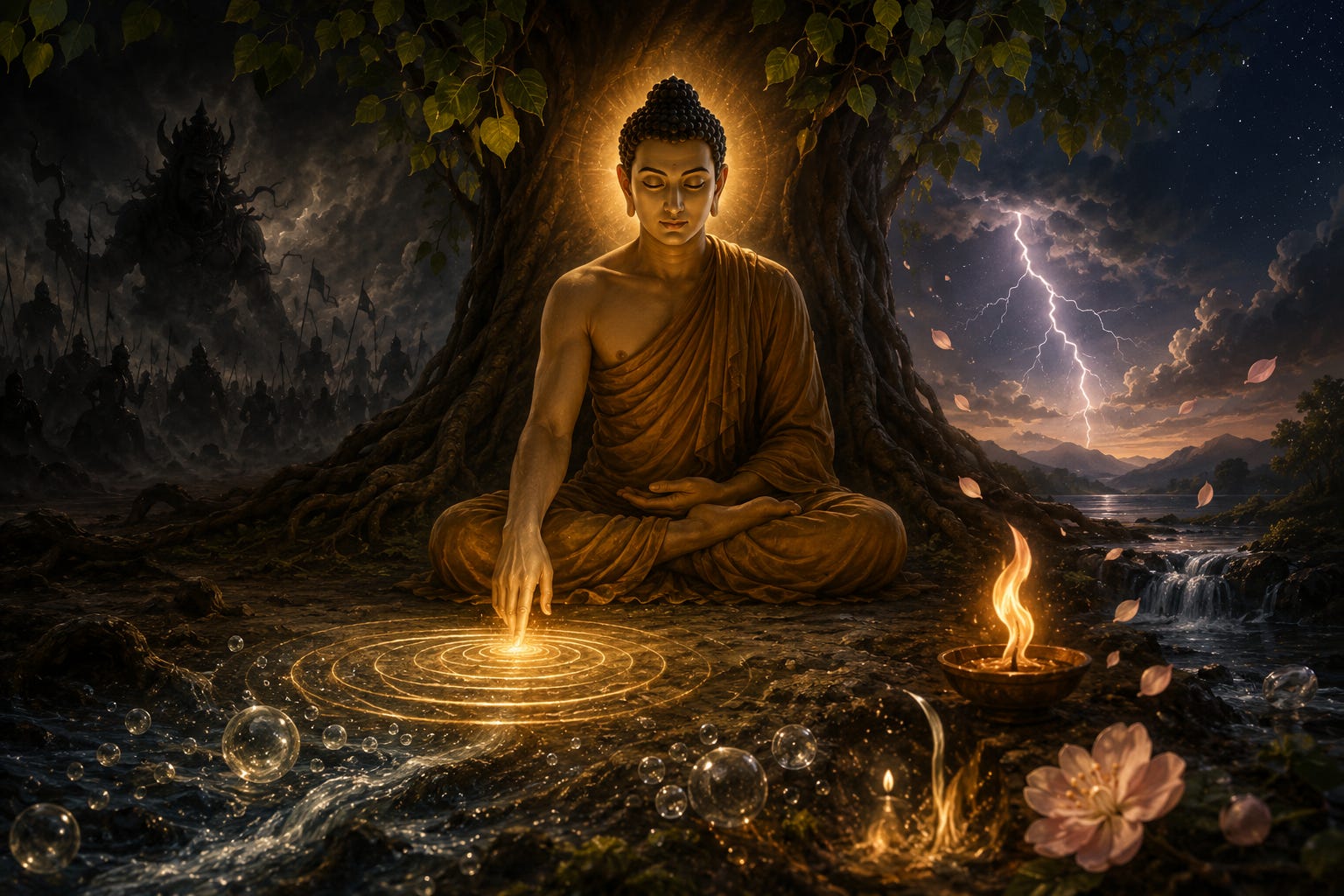
The Earth-Touching Buddha
There are few images in Buddhism more familiar than the Earth-Touching Buddha.
The Buddha sits beneath the Bodhi tree. His left hand rests quietly in his lap. His right hand extends over his knee, fingers reaching toward the ground.
It is a beautiful image.
A peaceful image.
But it is also the image of a confrontation.
Because, according to Buddhist tradition, the Buddha is not simply sitting there enjoying a particularly successful evening of meditation.
He is being challenged.
And the challenge is enormous.
The demon Māra has appeared with one final question:
“Who is your witness?”
The Challenge of Māra
Siddhārtha Gautama has spent years searching for an answer to the fundamental problem of human suffering.
He has studied with teachers.
He has practiced meditation.
He has experimented with extreme asceticism.
He has nearly starved himself to death.
And now, seated beneath the Bodhi tree, he stands—or, more accurately, sits—on the threshold of enlightenment.
Enter Māra.
In Buddhist tradition, Māra is often depicted as a demon, but he can also be understood as the personification of those activities that obstruct awakening: desire, fear, doubt, distraction, and attachment.
Māra attempts to disturb Siddhārtha’s meditation.
He sends armies.
He sends weapons.
He sends temptations.
Nothing works.
So Māra tries something different.
He challenges Siddhārtha’s authority.
By what right do you claim enlightenment?
What evidence do you have?
Who will testify on your behalf?
Who is your witness?
It is an extraordinary question.
And the Buddha gives an extraordinary answer.
He touches the earth.
Calling the Earth to Witness
Consider what the Buddha does not do.
He does not point toward the heavens.
He does not summon a god.
He does not produce a sacred text.
He does not appeal to a priesthood, a lineage, or an institution.
He simply reaches down and touches the ground.
Traditionally, this gesture is understood as calling the earth to witness the Buddha’s countless lifetimes of practice, generosity, and virtue.
The earth responds.
The ground trembles.
Māra is defeated.
And Siddhārtha Gautama becomes the Buddha.
It is a wonderful story.
But perhaps there is something more here.
Perhaps the gesture is not only an appeal to the earth as witness.
Perhaps it is also a statement about where the evidence for awakening can be found.
In nature itself.
Nature Has Been Teaching All Along
The Buddha repeatedly used images from the natural world to explain his teachings.
Bubbles in a stream.
A flickering flame.
A flash of lightning.
Flowers that bloom and inevitably fall.
Rivers that flow.
Seeds that arise only when the proper conditions are present.
These are not merely poetic decorations added to make difficult teachings more pleasant.
They point toward activity.
Look carefully at a bubble in a stream.
It arises.
It persists briefly.
It disappears.
Look carefully at a candle flame.
It appears stable.
And yet it is constantly changing.
Look at a flash of lightning.
For an instant, the darkness is illuminated.
Then the light disappears.
Nature is constantly demonstrating arising and disappearing.
Expansion and contraction.
Appearance and disappearance.
Manifestation and return.
The evidence is everywhere.
The problem is that we rarely look.
The Earth as Teacher
When Māra asks, “Who is your witness?”, the Buddha touches the earth.
Perhaps this gesture contains a profound inference.
The activity revealed through enlightenment is not something foreign to nature.
It is not something imported from another world.
It is not supernatural.
The same fundamental activity discovered through deep introspection is already manifesting everywhere.
The Buddha looks inward.
Nature displays outwardly.
And both point toward the same activity.
This may help explain why natural metaphors appear so frequently throughout Buddhist and Zen teachings.
Mountains.
Rivers.
Clouds.
Flowers.
Moonlight.
Empty valleys.
Morning stars.
These images are not simply beautiful.
They are evidence.
Nature is continually demonstrating the Dharma.
Buddha-Nature and the Natural World
This brings us to the idea of Buddha-nature.
Buddha-nature is sometimes treated as though it were a mysterious spiritual substance hidden somewhere deep inside us.
Perhaps we imagine that if we meditate long enough, practice hard enough, or become sufficiently enlightened, we will finally discover this special thing.
But perhaps Buddha-nature is much simpler.
Perhaps Buddha-nature refers to the same fundamental activity already visible throughout the natural world.
Things arise.
Things manifest.
Things change.
Things disappear.
And new things arise.
We do this.
Thoughts do this.
Emotions do this.
The sense of self does this.
Mountains do this.
Stars do this.
Bubbles in streams do this.
The difference is not necessarily in the activity.
The difference may simply be in our ability to see it clearly.
The Demon’s Mistake
Māra demands evidence.
And perhaps that is his mistake.
Because the evidence is everywhere.
He asks for a witness while standing on the witness.
He demands proof while surrounded by proof.
He challenges the Buddha to justify enlightenment while the entire natural world continually demonstrates the activity that enlightenment reveals.
That is almost funny.
Māra wants documentation.
The Buddha gives him a planet.
Why the Statue Still Matters
The Earth-Touching Buddha is more than a representation of an ancient story.
It is more than religious art.
And it is more than a familiar statue sitting quietly in meditation halls, gardens, and museums.
It captures a remarkable moment.
A question is asked:
“Who is your witness?”
And the Buddha responds without words.
He touches the earth.
Look here.
Look at nature.
Look at bubbles appearing and disappearing in a stream.
Look at the flame that seems permanent but changes from moment to moment.
Look at lightning suddenly illuminating the darkness.
Look at flowers blooming.
And look at those same flowers falling.
Then look at yourself.
Thoughts arise.
Feelings arise.
Perceptions arise.
The sense of “I” arises.
And all inevitably disappear.
Only to arise again.
Perhaps this is the deeper message of the Earth-Touching Buddha.
The truth of awakening does not require us to escape nature.
It requires us to finally notice what nature has been demonstrating all along.
Māra asked the Buddha:
“Who is your witness?”
The Buddha touched the earth.
Apparently, one witness was enough.


