
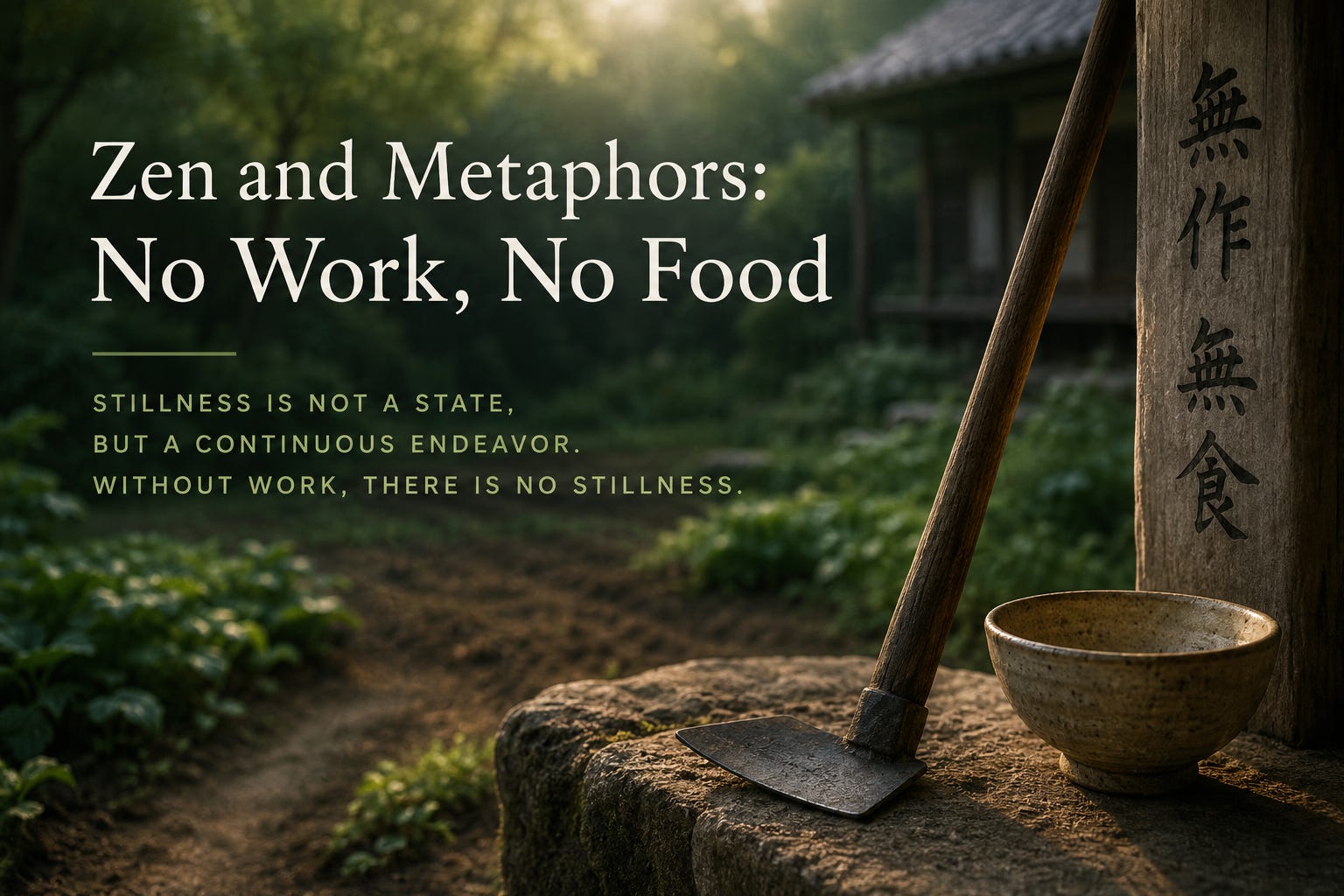
Zen and Metaphors: No Work, No Food
What if stillness isn’t something you find?
What if it’s something you do?
Among the more famous sayings associated with Zen is the simple maxim:
“No work, no food.”
The saying is traditionally associated with the Chinese Zen master Baizhang Huaihai. The basic idea is straightforward enough. Life in a Zen monastery required work. Fields had to be tended. Meals had to be prepared. Floors had to be swept.
And everyone participated.
Even the old master.
According to the traditional story, when Baizhang became elderly, his students became concerned about his continued physical labor. So they hid his gardening tools.
Baizhang responded by refusing to eat.
No work.
No food.
Eventually, the tools were returned.
It is a wonderful story about discipline, humility, and the practical realities of communal life.
But like many Zen stories, there may be another way to read it.
Because “no work, no food” may also tell us something important about stillness.
The Problem with Stillness
We tend to imagine stillness as a state.
You are either still or you are not.
The mind is quiet or the mind is busy.
The lake is smooth or the lake is covered with waves.
And this creates an obvious objective for Zen practice.
Get rid of the waves.
Stop the thoughts.
Achieve stillness.
The problem is that this turns stillness into a possession—something we acquire through meditation and then, presumably, try desperately not to lose.
But what if stillness doesn’t work that way?
What if stillness is not a state at all?
What if stillness is an activity?
Stillness Is the Work
Consider what actually happens during zazen.
You sit down.
You establish your posture.
You begin practicing.
And then...
You start thinking about lunch.
You return.
You remember something embarrassing you said twelve years ago.
You return.
You begin planning your afternoon.
You return.
You wonder how much longer the meditation period will last.
You return.
This may not feel particularly profound.
In fact, it can feel suspiciously like failure.
But perhaps this is precisely where we misunderstand the nature of practice.
The returning is not evidence that the practice has failed.
The returning is the practice.
Stillness does not necessarily appear because we have successfully eliminated every disturbance. Stillness appears through the persistent activity of practice.
Again.
And again.
And again.
No work, no food.
No practice, no stillness.
The Farmer Does Not Command the Field
The agricultural origins of the saying provide an especially useful metaphor.
A farmer cannot command a crop to grow.
Standing in the middle of a field and shouting at the vegetables is unlikely to improve the harvest.
But neither can the farmer simply sit on the porch and hope for the best.
The soil must be prepared.
Seeds must be planted.
Water must be provided.
Weeds must be removed.
Conditions must be established.
And then something happens.
The crop grows.
Zen practice may operate in much the same way.
We cannot simply command stillness to appear.
But we can establish conditions.
We sit.
We practice.
We notice.
We return.
We continue.
The work does not manufacture stillness.
The work establishes the conditions through which stillness can manifest.
The Danger of Becoming a Consumer of Stillness
There is another subtle lesson hidden inside the metaphor.
We often approach spiritual practice as consumers.
We want peace.
We want clarity.
We want insight.
We want enlightenment.
And preferably, we would like all of these things delivered with minimal inconvenience.
But “no work, no food” refuses that arrangement.
The saying reminds us that practice is participatory.
We cannot merely admire stillness.
We cannot collect quotations about stillness.
We cannot read books about stillness and assume that understanding the concept is equivalent to manifesting the activity.
At some point, someone has to pick up the hoe.
At some point, someone has to enter the field.
At some point, someone has to sit down and practice.
A Persistent Activity
This may be one of the most important corrections Zen offers to our ordinary understanding of stillness.
Stillness is not the absence of activity.
Stillness is a quality of activity.
And because it is an activity, it must continually manifest.
This helps explain why years of meditation do not produce a permanent reservoir of stillness that we can simply carry around.
Yesterday’s practice was yesterday’s practice.
Yesterday’s stillness was yesterday’s stillness.
Today, the field must be tended again.
This does not diminish the value of practice.
It reveals its value.
The work itself is the path.
The repeated returning.
The repeated releasing.
The repeated engagement with the conditions of this particular moment.
No Work, No Stillness
Perhaps, then, Baizhang’s famous saying can be expanded.
No work, no food.
No practice, no stillness.
Not because stillness is a reward handed out to those who work hard enough.
And not because Zen demands endless spiritual struggle.
But because stillness is not something separate from the activity that manifests it.
The farmer works the field.
The practitioner works with conditions.
And neither can simply declare the harvest complete.
Tomorrow, there will be more work.
Another field.
Another meditation period.
Another disturbance.
Another opportunity to return.
This is the strange generosity of the metaphor.
Stillness is not waiting for us at the end of the path.
Stillness is found in the persistent activity of walking it.
No work, no food.
No practice, no stillness.


