
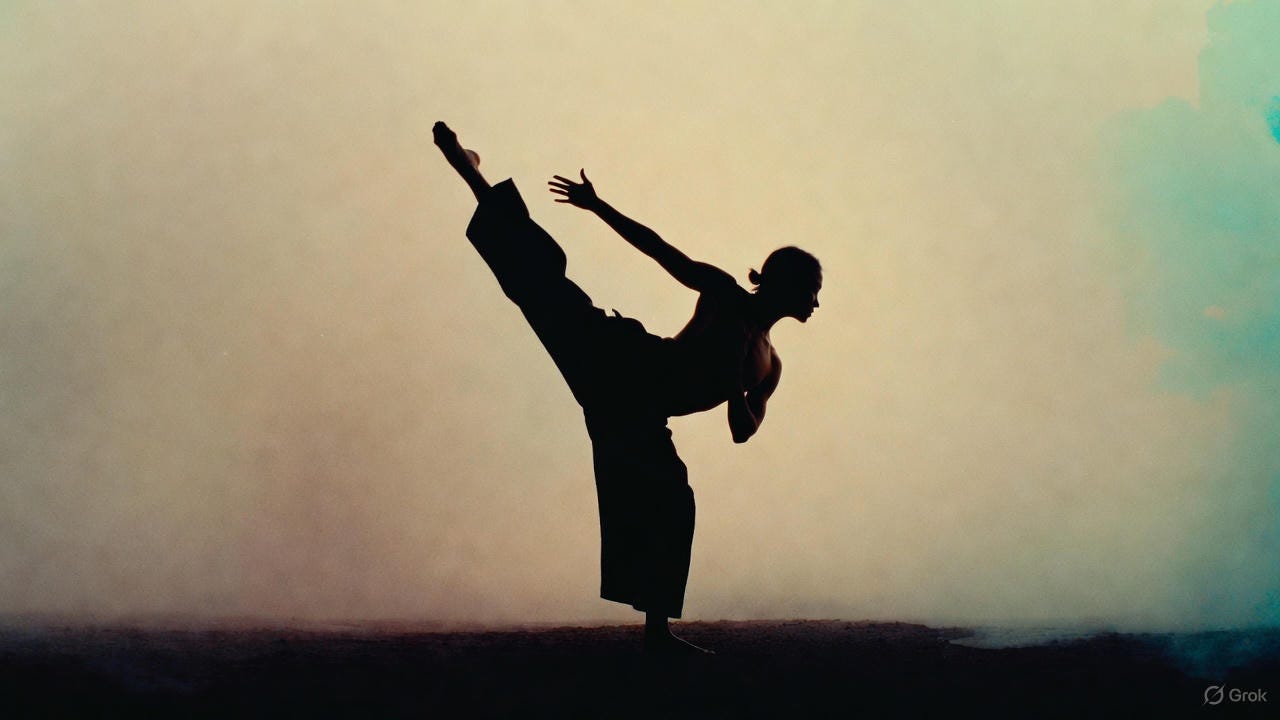
One of the quiet assumptions many people bring to Zen practice is that stillness must be cultivated through immobility. Sit down. Stop moving. Silence the body so the mind can settle. While this approach is certainly valid—and deeply rooted in the Zen tradition—it is not the only way the first gate opens. In fact, for many practitioners, stillness first reveals itself not in silence, but in motion.
In Zen terms, the first gate on the path is often described as the experience of stillness or equanimity. This is not emotional neutrality, suppression, or blankness. It is the recognition that awareness can remain unshaken even as thoughts, sensations, and actions arise. The mind ceases its compulsive interference, and a deeper calm becomes perceptible beneath activity. This is not awakening, but it is orientation—the first unmistakable sign that one’s ordinary way of inhabiting experience is not the only option.
Martial arts training provides an unusually direct route to this recognition. The dojo, much like the zendo, is a structured environment designed to strip away distraction. Forms, rituals, etiquette, repetition, and discipline all converge on the same demand: be fully present. At first, the student arrives full of tension and self-consciousness. Technique is forced. Breath is shallow. Attention flickers between fear, ambition, and self-judgment. But repetition has a way of wearing these habits down.
Over time, the body learns efficiency. Excess tension becomes counterproductive. Thinking ahead slows reaction. Trying to control outcomes interferes with timing. Slowly, the practitioner is forced—not philosophically, but physically—to let go. When that happens, something subtle but unmistakable appears. Action continues, but the sense of a controlling self recedes. The body moves appropriately. Awareness widens. And in the midst of motion, stillness emerges.
This is the paradox at the heart of the first Zen gate: stillness is not the opposite of movement. It is the absence of grasping within movement. The accomplished martial artist does not experience calm by stopping; they experience it by ceasing to interfere. In that moment, the distinction between stillness and action collapses. There is only responsiveness—clear, immediate, unforced.
It is important, however, not to confuse this with enlightenment. The martial arts can reliably deliver the experience of stillness, but they cannot, on their own, complete the Zen path. Stillness is a threshold, not a destination. Without further guidance—particularly from a living teacher who embodies realization—the experience can easily become another attachment, another state to chase or preserve.
And yet, as an entry point, the martial way is remarkably effective. It introduces stillness through the body, bypassing much of the conceptual struggle that frustrates beginning meditators. It demonstrates, viscerally, that awareness does not need to withdraw from the world to be free. It can move, strike, yield, and respond—without losing its center.
For many practitioners, this first glimpse is enough to change everything. Once stillness has been tasted in motion, it becomes impossible to believe that clarity belongs only on the cushion. The gate has been found. And having found it, one stands poised at the threshold, ready—perhaps for the first time—to step consciously onto the Zen path.


