
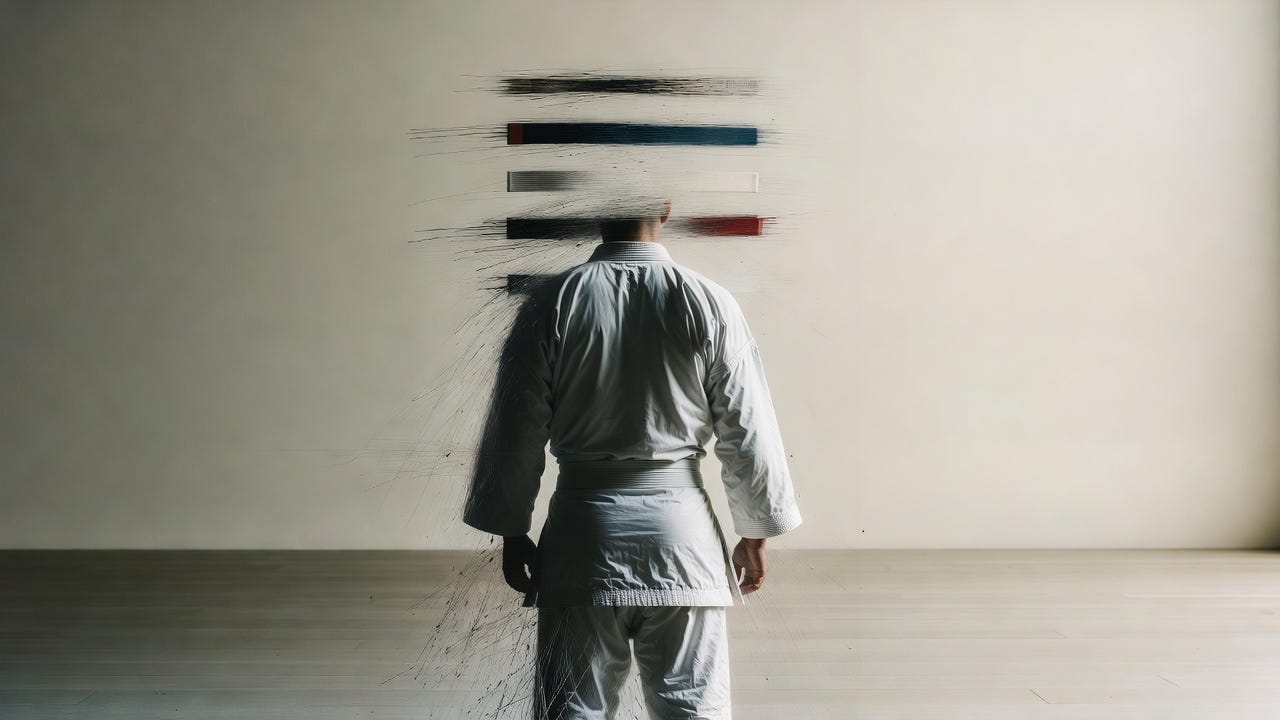
One of the most common assumptions about the martial arts is that they naturally align with Zen. Discipline, silence, repetition, presence—what could be more Zen than a quiet dojo at the start of class? And yet, tucked neatly into that calm space is a structure that deserves closer scrutiny: the ranking system.
Belts, stripes, dan certificates, titles, and hierarchies are so normalized that they rarely get questioned. They feel inevitable. Necessary, even. But from a Zen perspective, rank introduces a quiet tension—one that doesn’t announce itself loudly, but steadily reshapes how practice is experienced.
Historically, ranking systems are not ancient spiritual inheritances. The modern kyu–dan structure was introduced by Jigoro Kano in the late nineteenth century as a practical teaching innovation. It worked remarkably well. Rank made it possible to organize large groups, protect beginners, evaluate readiness, and spread martial arts beyond small, closed traditions. In short, rank solved real problems.
Zen, however, is not in the business of solving organizational problems. Zen is concerned with something far more slippery: the way the sense of “self” quietly forms, hardens, and defends itself.
This is where friction appears.
Rank almost inevitably encourages comparison. Am I progressing fast enough? Who’s ahead of me? Who’s behind me? How close am I to the next belt? Comparison quickly becomes identification: I am a yellow belt. I am senior to them. I am almost advanced. And identification fuels desire—desire for recognition, advancement, validation, and completion.
From a Zen standpoint, these are not neutral mental habits. They are the very movements that sustain delusion. Zen practice repeatedly points out that the self we protect, improve, and decorate is not something solid—it’s an activity. A pattern. A story continually reasserted. When rank becomes central, that story gains structure and reinforcement.
Even humility can become suspect. “I’m humble because I don’t care about rank” is still a story about me. Zen has little patience for such refinements. It doesn’t ask for better self-images; it asks for the willingness to see through the entire mechanism of self-making.
And yet, it would be dishonest to suggest that martial arts—and their ranking systems—are inherently opposed to Zen. They aren’t. The body-based discipline of martial training can be a powerful gateway into presence. Fear, balance, timing, resistance, and vulnerability have a way of stripping away abstraction. Many practitioners experience moments of genuine egolessness in training—moments where movement happens before thought, where there is no performer behind the technique.
Notably, those moments rarely feel ranked.
They arise when attention is fully absorbed, when comparison drops away, when the mind is too busy responding to circumstances to narrate who is doing well. Ironically, the most Zen moments in martial arts tend to occur when rank is forgotten, not emphasized.
The problem, then, is not rank as a tool. The problem is mistaking the tool for the path.
Zen has always warned against confusing markers with realization. Insight does not accumulate the way credentials do. Awakening does not obey a syllabus. And clarity cannot be certified. When rank is treated as scaffolding—temporary, functional, and ultimately disposable—it can coexist with Zen inquiry. But when it becomes identity, rank quietly turns into a shrine.
For practitioners interested in both Zen and the martial way, this calls for a particular kind of honesty. Use rank where it is useful. Respect it where it maintains safety and structure. But don’t let it tell you who you are. The moment rank becomes something to defend, display, or emotionally rely upon, it has already wandered far from anything Zen would recognize.
In the end, Zen doesn’t care what belt you wear. It cares about whether, even for a moment, the habit of being someone drops away—and the movement, the strike, the bow, or the breath simply happens.


