
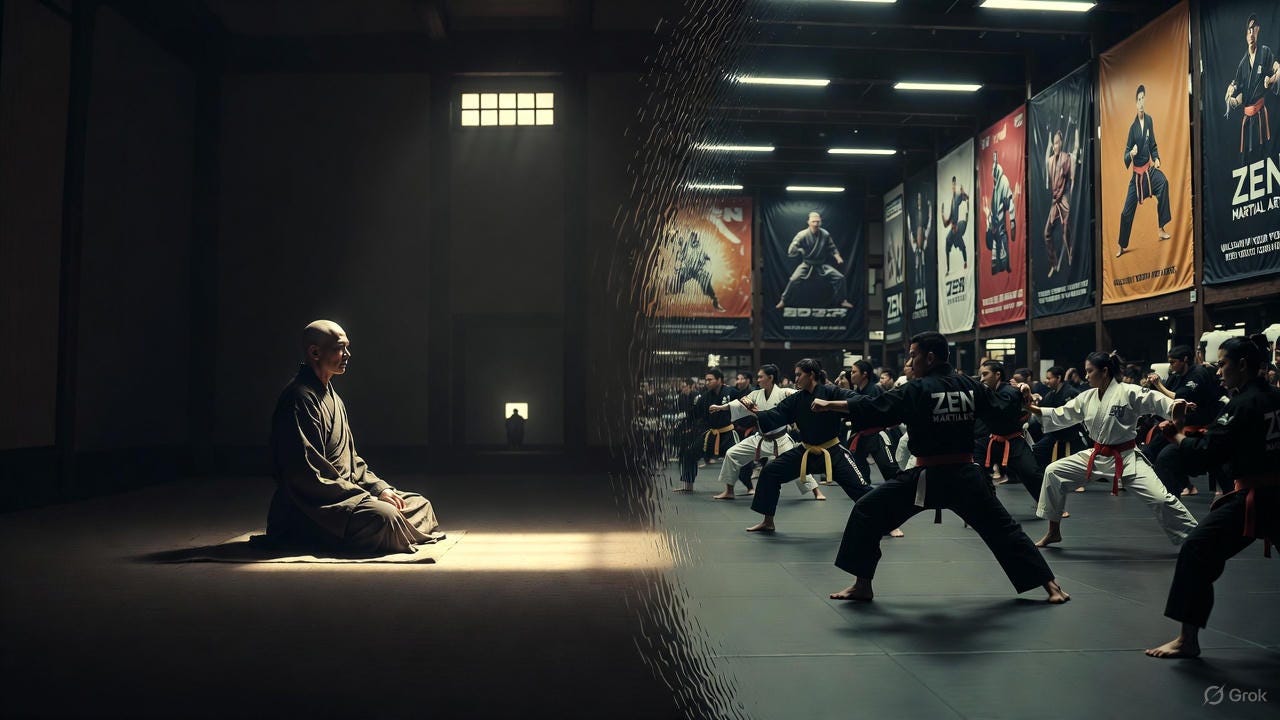
Have you noticed that Zen has somehow become the universal seasoning of modern culture? If you wander through a bookstore—virtual or otherwise—you’ll find Zen and baseball, Zen and creativity, Zen and making money, Zen and cooking, Zen and leadership, and, presumably, sometime next week: Zen and Folding Your Fitted Sheets Without Crying.
When everything is Zen… nothing is.
And that’s the strange cultural moment we find ourselves in. Zen has become an all-purpose adjective—calm, minimalist, vaguely philosophical, and extremely marketable. The martial arts, unsurprisingly, get pulled into the same gravitational field. After all, if you dim the lights, bow ceremonially, and move slowly enough, it must be Zen, right?
Well… not exactly. And that mismatch between appearance and intention is worth examining—especially for anyone who genuinely cares about what an effective Zen path looks like.
A Quiet Problem: Zen as Aesthetic, Not Path
Let’s get something out of the way: Zen is not an ambiance. It’s not a productivity upgrade. It’s not “that sense of peacefulness you get after a good stretch.” Zen, in its classical sense, is a path oriented toward one thing: the realization of non-duality. It examines the very relationship between “self” and “experience.”
And that is very different from the way the word “Zen” appears on book covers and martial arts websites.
In this popularized version, Zen becomes an accessory—a stylish lens that makes any activity seem deeper. It’s spiritual shorthand for “focused and calm.” But calmness is not Zen. Minimalism is not Zen. Even mindfulness is not Zen.
Those might be training conditions, but they aren’t the realization Zen is concerned with.
How Martial Arts Got Swept Into the Zen Current
Take aikido, karate, judo, taijiquan, or kendo. Practitioners often speak of these arts as “Zen in motion.” The idea is appealing. It feels profound. It sounds like something an ancient master would whisper while adjusting your stance.
But historically, it simply isn’t true.
Aikido was shaped overwhelmingly by Ōmoto-kyō, not Zen Buddhism.
Judo emerged from Japan’s modernization project, not Zen monasteries.
Karate is built on Okinawan and Confucian influences far more than Zen doctrine.
The martial arts certainly intersect with Zen values—discipline, presence, surrendering ego—but that doesn’t make them Zen any more than good posture makes you a yogi.
What’s really happening is cultural branding. Zen adds legitimacy, mystery, and a hint of spiritual depth. But branding is not practice. And once we confuse the two, we start mistaking the story for the training, the aesthetic for the insight.
When “Zen” Becomes a Slogan
This is where the real distortion occurs.
Once Zen becomes a market-friendly word, it becomes infinitely attachable:
Zen and leadership
Zen and cooking
Zen and martial arts
Zen and making more money while smiling softly into the distance
But none of these address the core of Zen: the direct investigation of self. The actual practice. The teacher-student relationship. The inquiry into how experience arises.
Zen asks you to look into the nature of the one trying to perfect anything at all—not to use Zen as a spiritual accessory to perfect your hobbies.
The Martial Way, Without the Myth
Here’s the good news: Zen can meaningfully illuminate martial arts practice. But not as branding, not as aesthetic, and not as a shortcut to mystical performance.
It illuminates the martial way only when approached honestly—through engagement with a living teacher, through disciplined inquiry, through the radical examination of the self that the martial arts often claim to encourage but rarely demand.
When everything is Zen, Zen dissolves.
When Zen becomes branding, it becomes noise.
When Zen is reclaimed as practice, the path reappears.
And this is where our real work begins.
Thanks for reading. If this topic sparks questions or you want future deep dives on the overlap—and confusion—between Zen, culture, and the martial arts, drop a comment or share it with someone who’s been promised “Zen-like focus” at their local dojo.


